


BLOG
CONTENTS
- EU REACH Tightens NPEOs Limit for Paper ImportsAug 09, 2026
- EU Enforces NPEOs Ban on Coated Paper ImportsAug 08, 2026
- EU REACH Restriction on NPEOs in Paper Coatings Takes EffectAug 07, 2026
- EU REACH Tightens Paper Chemical Rules From Aug. 15Aug 06, 2026
- ECHA Adds 3 SVHCs, Exporters Recheck DeclarationsAug 05, 2026
ECHA Adds 3 SVHCs, Exporters Recheck Declarations
On August 4, 2026, the European Chemicals Agency (ECHA) updated the SVHC Candidate List by adding three new substances related to flame retardants and dye intermediates. For exporters serving the EU market, this is not a routine regulatory update: it directly affects paper, coated paper, specialty paper, and related chemical additives such as defoamers and dispersants where relevant auxiliaries may be present. Chinese exporters, overseas importers, and distributors now need to treat compliance documentation as an immediate operational issue because outdated SVHC declarations in REACH notifications may lead to customs delays or returned shipments.
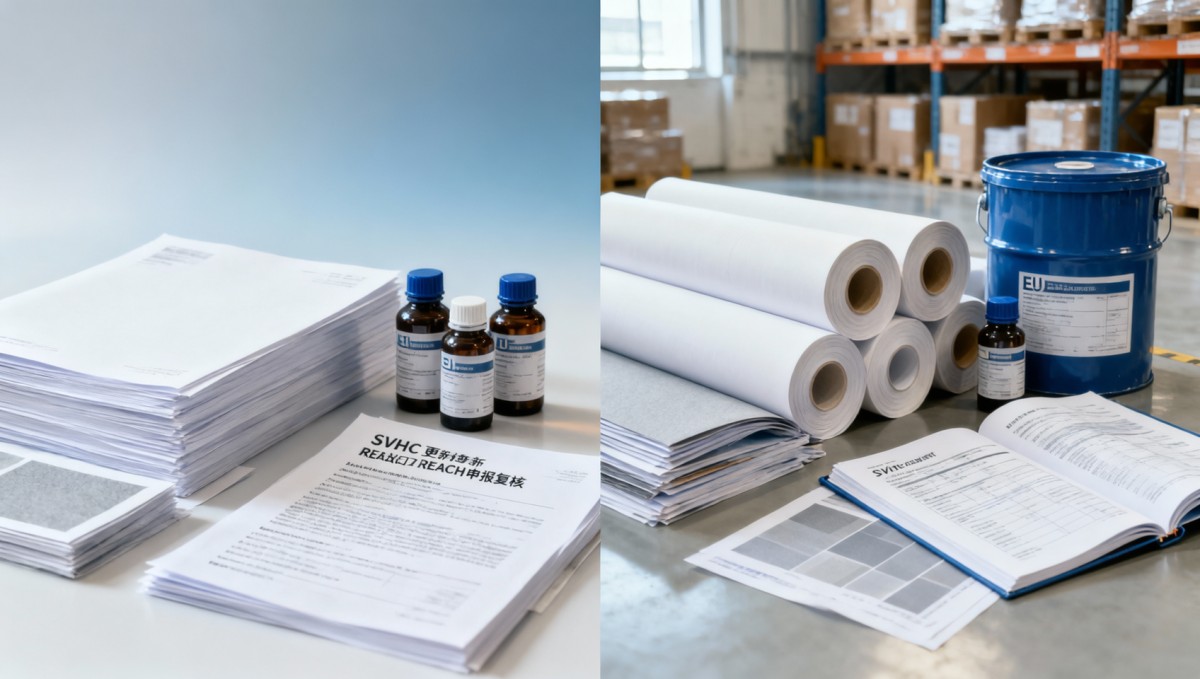
What the August 4 update confirms
The confirmed development is that ECHA formally added three new substances to the SVHC Candidate List on August 4, 2026. The substances involved are described in the provided information as relating to flame retardants and dye intermediates.
The same information also confirms a direct impact on exports to Europe involving paper products and supporting chemical products that may contain the relevant additives. The affected scope specifically includes paper, coated paper, specialty paper, and associated chemical additives such as defoamers and dispersants.
It is also confirmed that, from August 1, 2026, Chinese exporters are required to update SVHC declarations in REACH notifications. If those declarations are not updated, the stated risks include customs clearance delays or shipment returns. Overseas importers and distributors are likewise expected to check whether supplier compliance documents remain valid.
Where the pressure is likely to appear first
Exporters of paper and paper-based products
From an industry perspective, exporters of paper, coated paper, and specialty paper are exposed because the issue is tied to whether relevant auxiliaries are present in the products being shipped to the EU. The impact is most likely to appear in export documentation, customer compliance responses, and shipment release timing. What deserves closer attention is whether existing declarations still match the updated SVHC Candidate List.
Suppliers of supporting chemical additives
Producers and traders of additives such as defoamers and dispersants may face pressure at the material disclosure stage. Analysis shows that these businesses sit close to the source of substance information, so any gap in formulation-related compliance statements can affect downstream customers that rely on them for REACH-related declarations. The practical issue is less about broad market commentary and more about the quality and timeliness of supplier documentation.
Importers and distributors in the EU market
For overseas importers and distributors, the immediate concern is document validity. Observably, these market participants are in a position where they may need to verify supplier files before goods proceed smoothly through trade channels. The effect may show up in supplier screening, document refresh cycles, and risk checks before customs handling or onward distribution.
Cross-border supply chain and delivery functions
Logistics, trade compliance, and customer service teams may also feel the impact even if they are not the legal owner of the product formulation. Analysis shows that once a declaration update becomes necessary, delays can move quickly from compliance review into shipping schedules, delivery commitments, and customer communication. In that sense, this is also a coordination issue across sales, regulatory, and fulfillment functions.
What companies should review now
Check whether current declarations still match the new list
The first practical task is to verify whether existing SVHC statements used in REACH notifications remain current after the August 4 update. For companies exporting to the EU, the key point is not simply having a declaration on file, but whether the declaration reflects the revised Candidate List position described in the provided information.
Prioritize products that rely on relevant auxiliaries
What deserves closer attention is the product range most likely to involve the referenced substance categories, especially paper products and chemical additives named in the provided information. A focused review of those categories can help businesses identify where documentation risk is more immediate.
Reconfirm supplier document validity before shipment
For importers, distributors, and exporters working through multiple suppliers, a current supplier file matters as much as an internal compliance statement. Analysis shows that document validity should be checked before shipment rather than after goods face clearance questions. This is particularly relevant where supporting declarations come from upstream chemical suppliers.
Prepare for customer and customs-facing communication
Companies should also be ready to respond quickly if customers, distributors, or customs-related parties ask for updated compliance evidence. The business issue here is operational readiness: whether teams can provide consistent documentation, explain any declaration updates, and avoid disruption to delivery timelines.
Why this matters beyond a single list update
Analysis shows that this development should be understood as more than a formal amendment to the SVHC Candidate List. In the short term, it creates an immediate documentation and shipment-risk issue for exporters and their trading partners. At the same time, it also signals that compliance claims tied to paper-related auxiliaries and supporting chemicals cannot be treated as static paperwork once market access depends on current declarations.
It is more appropriate to understand this as a near-term compliance trigger with longer-term monitoring value. The immediate result described in the provided information is clear: declarations must be updated and supplier documents checked. Beyond that, the broader industry meaning lies in how quickly businesses can connect regulatory updates with product-level documentation control.
How this update is best understood now
At this stage, the most balanced reading is that the ECHA action is an operationally significant compliance development rather than a fully defined market shift. The confirmed impact already reaches export paperwork, customs risk, and supplier document review for affected paper and chemical products. Whether the effect remains limited to document refresh work or develops into broader trade friction will depend on how promptly companies verify substance exposure and update compliance files.
For now, this is best understood as an actionable regulatory change with immediate consequences for EU-bound shipments, while still remaining a development that merits continued observation as companies and distributors work through implementation.
Basis of this article and points for continued verification
This article is based on the user-provided news title, event date, and event summary concerning ECHA's August 4, 2026 update to the SVHC Candidate List and the resulting compliance implications for paper and chemical exports to Europe.
For this type of development, relevant source categories typically include official regulatory notices, company compliance statements, industry association updates, authoritative media reporting, and standard-setting or regulatory documentation. A specific official source link was not provided in the input, so the precise source document still needs ongoing verification.
Further attention should remain on any subsequent official wording, implementation clarifications, and document-related requirements affecting REACH notifications, supplier declarations, and shipment compliance checks.