


CONTENTS
- Pulp and Paper Defoamer Selection Guide: How to Choose a Suitable Foam Control SolutionJun 22, 2026
- The difference between water treatment defoamers and polyether defoamersApr 13, 2026
- Defoamer For Wastewater TreatmentApr 13, 2026
- Industrial Paper Strength Solutions: Technical Guide to Dry and Wet Strength AdditivesApr 07, 2026
- Optimizing Paper Sizing Performance with Grade A AKD Wax 1840 and High-Polymer EmulsionApr 02, 2026
Optimizing Paper Sizing Performance with Grade A AKD Wax 1840 and High-Polymer Emulsion
Introduction
In the competitive paper chemicals market, achieving a consistent Cobb60 value is the benchmark for quality. The efficiency of the neutral sizing process depends on two critical factors: the chemical purity of the AKD Waxand the stability of the High-Polymer AKD Emulsion.
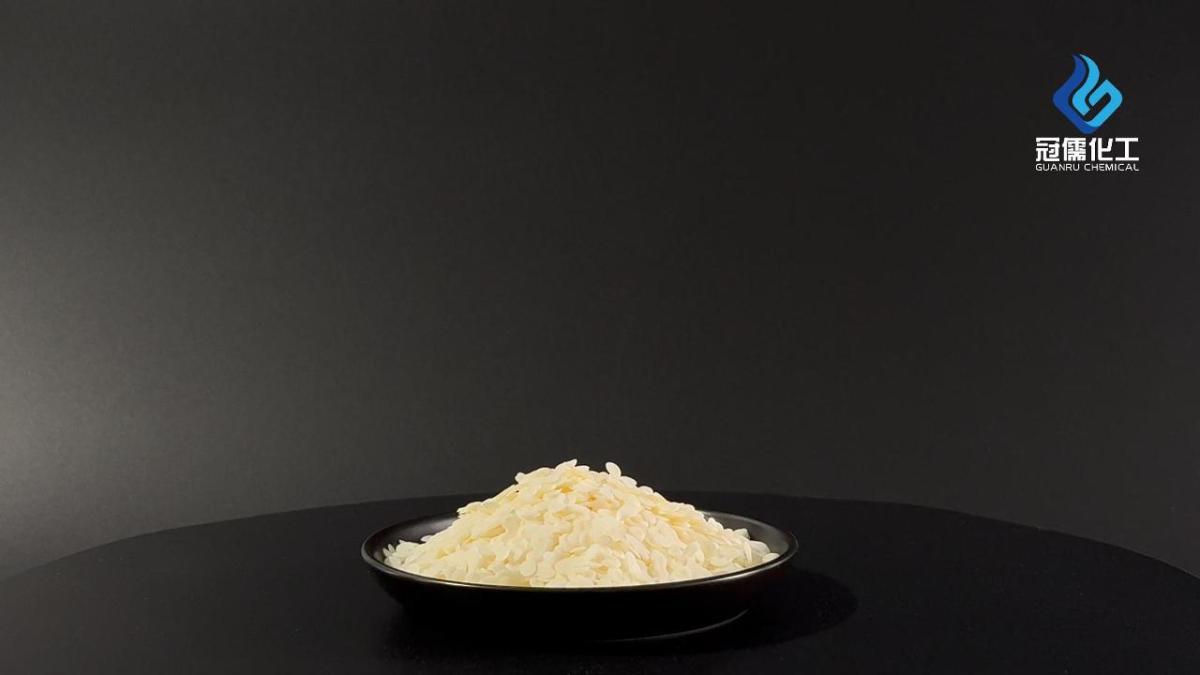
At Guanru Chem, we provide a vertically integrated solution, starting from our high-purity Grade A AKD 1840 Wax to our ready-to-use Cationic AKD Emulsions, designed to deliver superior hydrophobicity for packaging and industrial paper.
The Quality Source: Technical Specifications of Grade A AKD 1840 Wax
AKD Wax Powder: Technical Specifications
The performance of any AKD sizing agent begins with the wax. Our AKD 1840 Wax is a premium organic intermediate specifically developed for high-end emulsification.
High Purity (Assay): ≥ 90.0%. A purity level of 90% or higher is essential to ensure maximum active content and prevent the common issue of "Sizing Reversion."
Precise Melting Point: 48.0°C - 51.0°C. This specific melting range ensures a smoother emulsification process, resulting in a more uniform particle distribution on the paper fibers.
Low Iodine Value: ≤ 43.0 gI₂/100g. This ensures excellent chemical stability and a long shelf life, preventing hydrolysis during transport and storage in warm climates.
Acid Value Control: ≤ 5.0 mg KOH/g. Minimizing the acid value reduces the formation of byproducts that can interfere with the sizing reaction.
Field Application: High-Polymer AKD Neutral Sizing Agent for Paper Mills
Our GR-AKD High-Polymer Emulsion is a cationic, milky white liquid formulated for both internal and surface sizing applications.
Key Features of Our Cationic AKD Emulsion
Customizable Solid Content: We offer standard concentrations of 15% ± 1% and 19% ± 1% to meet the specific requirements of different paper machine speeds and paper grades.
Cationic Charge Protection: Since cellulose fibers are negatively charged, our cationic emulsion ensures rapid adsorption and high retention rates, leading to a significant reduction in chemical consumption.
Optimized pH Stability: With a storage pH of 2.0 - 5.0, the emulsion remains stable and active for up to 3 months when stored between 4°C and 30°C.
Technical Insights: How to Control Cobb60 and Prevent Sizing Reversion
Achieving a low Cobb60 value requires more than just high-quality chemicals; it requires precise process control:
Drying Temperature: AKD requires heat to react with cellulose. Ensure the drying section reaches 105°C - 115°C to complete the "molecular orientation."
Retention Aid Coordination: Using AKD in conjunction with Cationic Starch or Polyacrylamide (PAM) can enhance the retention of AKD particles, reducing the cost per ton of paper.
Storage Management: AKD is sensitive to hydrolysis. Always store AKD emulsion in a cool, ventilated area to maintain its sizing efficiency.
Troubleshooting: Achieving the Best Results in Paper Production
Why Choose Guanru Chem for Your AKD Requirements?
With years of experience in the chemical industry, Guanru Chem understands the pain points of modern paper mills. Our AKD 1840 Wax and High-Polymer Emulsions are exported to over 20 countries, helping clients achieve higher sizing efficiency and lower production costs.
FAQ Section
Frequently Asked Questions (FAQ) about AKD Sizing
1.Why is the Cobb60 value of my paper still high after using AKD?
A high Cobb value usually indicates poor sizing efficiency. This can be caused by:
Insufficient Curing: AKD needs heat (105°C-115°C) to react. If the drying section temperature is too low, the sizing effect won't fully develop.
Low Retention: If the AKD particles aren't sticking to the fibers, they end up in the white water. Ensure you are using a Cationic AKD Emulsion with a proper retention aid like PAM.
2. What is "Sizing Reversion" and how can I prevent it?
Sizing reversion occurs when the paper is water-resistant immediately after production but loses that resistance during storage.
The Cause: Often due to using low-purity AKD wax or high levels of hydrolysis products.
The Solution: Always use Grade A AKD Wax (Assay ≥ 90.0%). High-purity wax, like our 1840 series, has a lower hydrolysis rate and superior long-term stability.
3. Can I use AKD Sizing Agent in acidic papermaking?
No. AKD is a neutral/alkaline sizing agent designed for a pH range of 7.5 to 8.5. In acidic conditions (pH < 6.5), AKD reacts very slowly and hydrolyzes quickly, leading to a complete loss of sizing efficiency.
4. How long can AKD Emulsion be stored?
Standard 15% or 19% AKD Emulsion has a shelf life of 3 months when stored in a cool, dry place (4°C - 30°C). Since AKD is sensitive to water (hydrolysis), avoid storing it in temperatures above 35°C for extended periods.
5. What is the difference between AKD Wax 1840 and 1865?
The main difference lies in the carbon chain length and melting point. 1840 wax (Melting point 48.0°C - 51.0°C) is the most common choice for general emulsification. 1865 has a slightly higher melting point and is often used for specific high-stability or high-temperature applications.