products
‹
›
‹
›
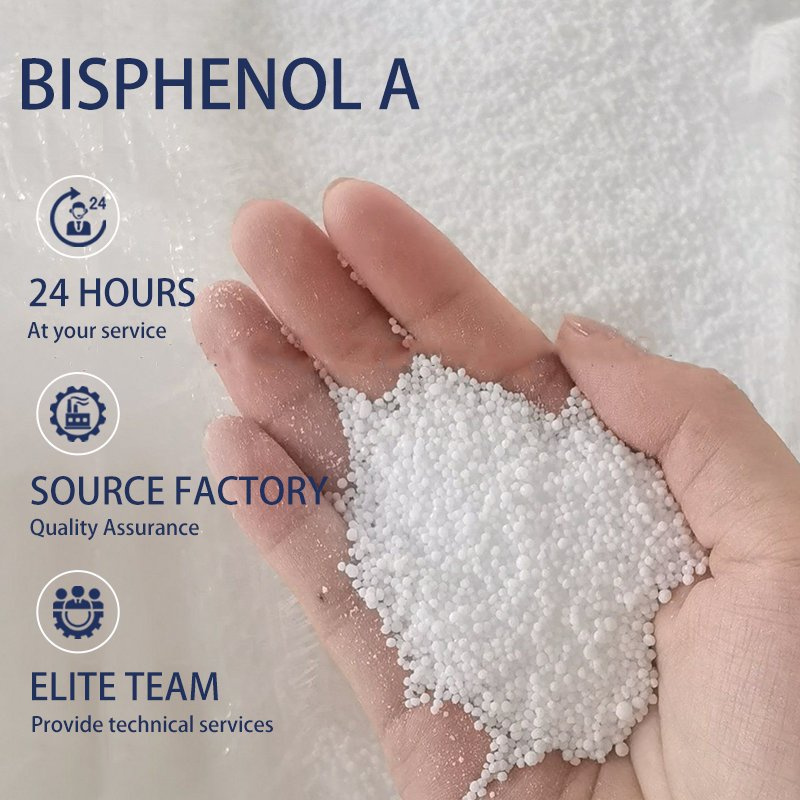
Bisphenol A
Product Parameters
Product Description
Bisphenol a with CAS 80-05-7
Bisphenol A (BPA) is a chemical compound primarily used in the manufacturing of various plastics. It is a colourless solid which is soluble in most common organic solvents, but has almost no solubility in water. BPA is produced on an industrial scale by the condensation of phenol and another chemical raw material, and has a global production scale which is expected to reach 10 million tonnes in 2022.BPA's largest single application is as a co-monomer in the production of polycarbonates, which accounts for 65-70% of all BPA production. The manufacturing of epoxy resins and vinyl ester resins accounts for 25-30% of BPA use. The remaining 5% is used as a major component of several high-performance plastics, and as a minor additive in PVC, polyurethane, thermal paper, and several other materials. It is not a plasticizer, although it is often wrongly labelled as such.

Application areas
1.Polycarbonates
Between about 65-70% of all bisphenol A is used to make polycarbonate plastics, which can consists of nearly 90% BPA by mass. Polymerisation is achieved by a reaction with phosgene, conducted under biphasic conditions; the hydrochloric acid is scavenged with aqueous base. This process converts the individual molecules of BPA into large polymer chains, effectively trapping them.
2.Epoxy and vinyl ester resins
About 25-30% of all BPA is used in the manufacture of epoxy resins and vinyl ester resins. For epoxy resin, it is first converted to its diglycidyl ether (usually abbreviated BADGE or DGEBA). This is achieved by a reaction with epichlorohydrin under basic conditions.
Some of this is further reacted with methacrylic acid to form bis-GMA, which is used to make vinyl ester resins.
3.Minor uses
The remaining 5% of BPA is used in a wide range of applications, many of which involve plastic.BPA is a major component of several high-performance plastics; the production of these is low compared to other plastics but still equals several thousand tons a year. Comparatively minor amounts of BPA are also used as additives or modifiers in some commodity plastics. These materials are much more common, but their BPA content will be low.
4.Plastics
As a major component
Polycyanurates can be produced from BPA by way of its cyanate ester.
Polyetherimides can be produced from BPA. They are used in medical devices and other high-performance instrumentation.
Polybenzoxazines may be produced from a number of biphenols, including BPA.
Polysulfones can be produced from BPA and bis(4-chlorophenyl) sulfone, forming poly(bisphenol-A sulfone) (PSF). It is used as a high-performance alternative to polycarbonate.
Bisphenol-A formaldehyde resins are a subset of phenol formaldehyde resins. They are used in the production of high-pressure laminates
Packaging and storage
Packing:
900kg/bag,18MT in 20'FCL.
Request a Quote
Related Recommendations