


BLOG
CONTENTS
- EU REACH Tightens NPEOs Limit for Paper ImportsAug 09, 2026
- EU Enforces NPEOs Ban on Coated Paper ImportsAug 08, 2026
- EU REACH Restriction on NPEOs in Paper Coatings Takes EffectAug 07, 2026
- EU REACH Tightens Paper Chemical Rules From Aug. 15Aug 06, 2026
- ECHA Adds 3 SVHCs, Exporters Recheck DeclarationsAug 05, 2026
China Halts Industrial Sulfuric Acid Exports from May 2026
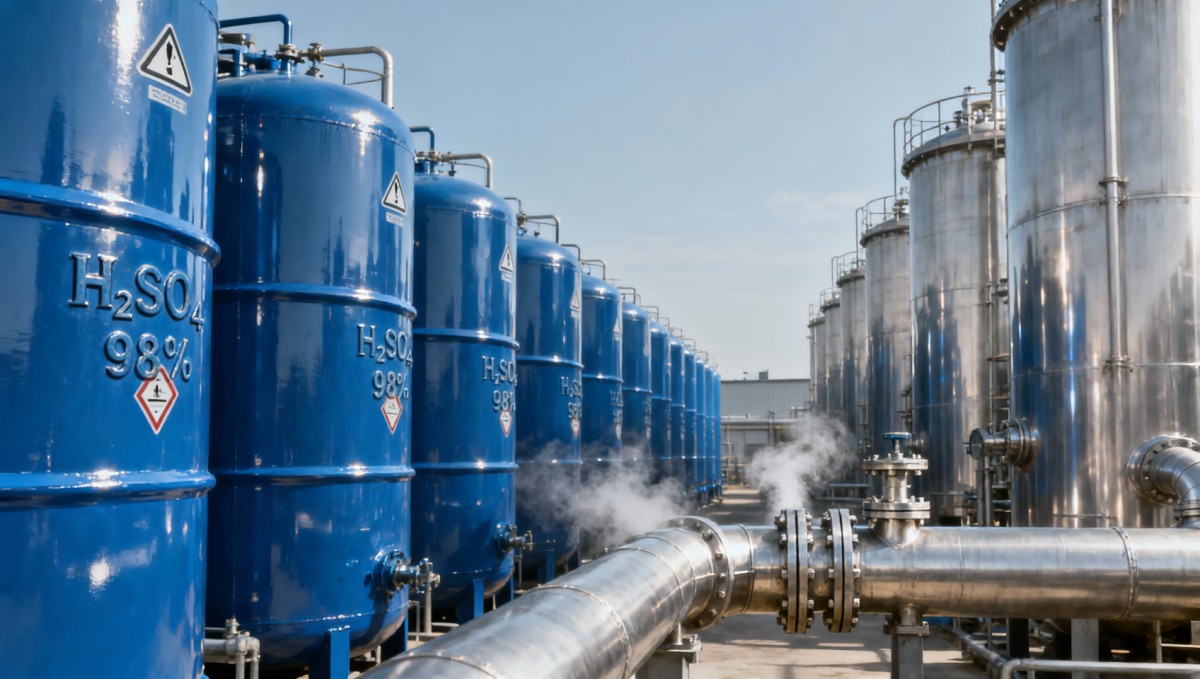
Starting 1 May 2026, China has implemented a full export suspension of ordinary industrial sulfuric acid and smelting-byproduct sulfuric acid—excluding electronic-grade high-purity sulfuric acid—triggering urgent supply reassessments across global copper mining, nickel-cobalt refining, and lithium-ion battery cathode material manufacturing sectors.
Event Overview
Effective 1 May 2026, the People’s Republic of China formally suspended exports of ordinary industrial sulfuric acid and sulfuric acid derived from metal smelting processes. Electronic-grade high-purity sulfuric acid is explicitly exempted. This measure follows no prior public consultation or phased rollout. As of early May 2026, the restriction is in force and publicly confirmed by multiple trade sources. Global sulfate supply chains have reacted immediately: spot prices at Asian ports rose 101% compared to late February 2026 levels, and average lead times extended to 8–12 weeks.
Industries Affected
Direct Trading Enterprises
Companies engaged in cross-border sulfuric acid trading—including distributors and commodity traders headquartered in Singapore, Dubai, and Rotterdam—are directly impacted due to the loss of China as a source for bulk industrial-grade material. Their inventory planning, contract fulfillment, and logistics scheduling are disrupted, especially for shipments destined for South America and Southeast Asia.
Raw Material Procurement Entities
Procurement departments at copper mines (e.g., in Chile and Peru), cobalt-nickel refineries (e.g., in Indonesia and the DRC), and cathode active material (CAM) producers globally rely on imported industrial sulfuric acid for leaching, purification, and precursor synthesis. With ~23% of global sulfuric acid exports previously sourced from China, buyers face immediate gaps in contractual supply assurance and compliance documentation.
Processing & Manufacturing Firms
Manufacturers using sulfuric acid as a process reagent—including hydrometallurgical plants and battery materials producers—face operational risk. Longer lead times and price volatility complicate batch planning, quality control consistency, and cost forecasting. Production ramp-ups or new line commissioning scheduled for H2 2026 may require technical validation under revised acid specifications or alternative chemistries.
Supply Chain & Logistics Service Providers
Freight forwarders, port agents, and customs brokers handling sulfuric acid consignments report increased documentation scrutiny and shipment delays. The exemption for electronic-grade acid introduces classification ambiguity—requiring precise product certification and origin verification—adding administrative burden and potential clearance bottlenecks at key transshipment hubs.
What Enterprises and Practitioners Should Monitor and Do Now
Track official clarifications on scope and enforcement
Monitor announcements from China’s Ministry of Commerce (MOFCOM) and General Administration of Customs (GACC) for updates on definitions (e.g., exact purity thresholds distinguishing ‘industrial’ from ‘electronic-grade’), exceptions, or possible licensing pathways. Current policy language leaves room for interpretation—especially regarding blended or repackaged material.
Validate supplier alternatives with technical and regulatory alignment
Priority should be given to verifying non-Chinese suppliers’ ability to meet required concentration (e.g., 98% H₂SO₄), impurity profiles (e.g., chloride, heavy metals), packaging standards, and SDS compliance for target end-uses. Not all regional producers meet specifications for copper heap leaching or CAM synthesis—technical due diligence is non-substitutable.
Assess exposure across procurement contracts and logistics nodes
Map existing purchase orders, incoterms, and port-of-discharge clauses to identify dependencies on Chinese-origin acid. Review force majeure clauses, substitution rights, and penalty triggers. Simultaneously evaluate backup routing options—e.g., shifting from Shanghai/Ningbo to Middle Eastern or Russian-origin supplies—and associated transit time, insurance, and customs clearance implications.
Prepare for extended lead-time planning cycles
Adjust internal procurement calendars to reflect the current 8–12 week lead time norm. Align this with production scheduling systems and safety stock policies—particularly where sulfuric acid is a critical path input. Consider staged ordering or consignment stocking arrangements with vetted regional suppliers to mitigate delivery risk.
Editorial Perspective / Industry Observation
Observably, this export suspension functions less as an isolated trade measure and more as a structural recalibration of China’s role in global basic chemical supply chains. Analysis shows that the timing—coinciding with tightened Middle Eastern sulfur availability—amplifies systemic vulnerability rather than merely shifting sourcing geography. From an industry perspective, the policy signals a broader trend: increasing national-level prioritization of domestic resource allocation and environmental compliance over export competitiveness in foundational industrial chemicals. It is not yet clear whether this is a temporary adjustment or part of a longer-term strategic realignment; sustained observation of related policy documents (e.g., China’s 15th Five-Year Plan implementation guidelines for non-ferrous metallurgy) will be essential.
Current evidence suggests the impact is already materializing—not merely anticipated. However, the absence of formal regulatory text published in English or multilingual formats means implementation details remain partially opaque. This makes real-time operational adaptation more urgent than theoretical scenario planning.
Conclusion
This export suspension represents a concrete inflection point for global sulfate-dependent industries—not a speculative risk but an active constraint reshaping procurement logic, technical qualification protocols, and supply chain resilience frameworks. It is best understood not as a short-term disruption, but as a catalyst accelerating pre-existing trends toward regionalized sourcing, stricter chemical traceability, and deeper integration between raw material policy and downstream manufacturing strategy.
Information Sources
Main sources include publicly reported trade notices issued by China’s General Administration of Customs (GACC), verified pricing data from Asian port terminals (Shanghai, Busan, Singapore), and procurement alerts circulated by industry associations including the International Copper Association (ICA) and the Cobalt Institute. Ongoing developments—including potential exemptions, revised HS code classifications, or bilateral trade negotiations—remain under observation and are not yet confirmed.