


BLOG
CONTENTS
- Brazil Mulls Doubling Tariffs on Low-Cost Paper ImportsAug 17, 2026
- China’s Paper Industry to Join Carbon Market in Phases, Raising Export Compliance PressureAug 16, 2026
- China’s Paper Sector to Enter the National Carbon Market in 2026, Raising Export Compliance PressureAug 15, 2026
- China Paper Exports Jump 92.5% in Jan-MayAug 14, 2026
- The EU's PPWR enters into force today, raising compliance thresholds for paper-based packaging exported to the EU.Aug 13, 2026
EU Paper Recycling Labels Reshape Export Access
Image Placement Plan
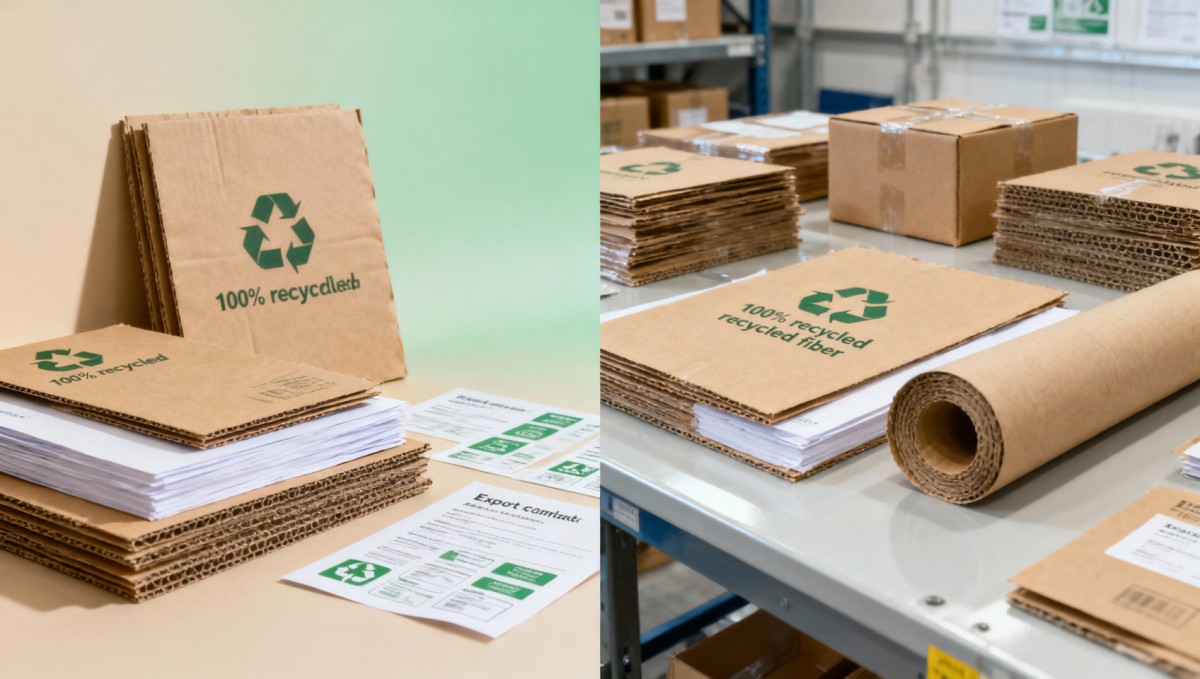
Place one visual after the opening paragraph to illustrate recyclable labelling requirements for paper-based packaging entering the EU market.
From 1 June 2026, the EU began applying new recyclable labelling requirements linked to PPWR and EN 13428:2026, directly affecting Chinese exporters of paper-based packaging such as containerboard, white cartonboard and kraft liner because market entry now depends on compliant on-product or label-based recycling and fibre-origin declarations.
Confirmed Regulatory Change for Paper-Based Packaging
According to the provided event information, the EU formally implemented the revised EN 13428:2026 supporting standard under Regulation (EU) 2025/2476 on packaging and packaging waste, known as PPWR, from 1 June 2026.
The requirement applies to paper-based packaging products entering the EU market, including containerboard, white cartonboard and kraft liner. These products must carry a unified recyclability icon and a fibre-source declaration either on the product itself or on the product label.
The stated examples of fibre-source declarations include '100% recycled' and 'FSC-certified virgin fiber'. Products without compliant labelling may be refused by customs authorities in EU member states or face the risk of market withdrawal.
The regulation directly affects the export preparation, label design and third-party certification arrangements of Chinese paper companies shipping packaging paper to the EU.
How the Rule Change Reaches Different Market Roles
Export-focused trading companies
Direct trading companies are affected because customs acceptance and downstream market access now depend on whether paper-based packaging products carry the required recyclability icon and fibre-origin statement. The impact is likely to appear in order review, export documentation, label confirmation, shipment release and customer compliance communication.
These companies need to pay closer attention to whether product labels match the revised EN 13428:2026 requirements before shipment, and whether buyers require additional evidence from third-party certification or suppliers.
Raw material procurement businesses
Raw material procurement teams are affected because fibre-origin declarations such as '100% recycled' or 'FSC-certified virgin fiber' must be supported by the material information used in production. The requirement links purchasing decisions more closely with labelling accuracy and certification readiness.
Procurement-related changes may arise in supplier qualification, fibre-source verification, purchase specification review and internal traceability records. Companies may need to check whether raw material descriptions can support the statements printed on products or labels.
Converting and manufacturing operations
Processing and manufacturing companies are affected because the new rule concerns the physical presentation of information on the product body or label. This makes label design, printing layout, packaging artwork approval and production batch control more important in export preparation.
Manufacturers may need to review how recyclability icons and fibre-source declarations are incorporated into existing product specifications, while ensuring that changes are aligned with customer requirements and third-party certification arrangements.
Supply chain service providers
Supply chain service providers, including logistics coordination and compliance support roles, are affected because non-compliant labelling may lead to customs refusal or market withdrawal risk. Their work may involve pre-shipment checks, document coordination and communication between exporters, buyers and certification parties.
They should watch for changes in inspection points, shipment timing, document completeness and any buyer-side requirements related to label evidence or certification confirmation.
Practical Compliance Priorities for Exporters
Match label content with the revised standard
Companies exporting paper-based packaging to the EU should review whether each product carries the required unified recyclability icon and an appropriate fibre-source declaration. The review should cover both product-body marking and label-based marking, depending on how the product is supplied.
Align fibre claims with certification evidence
Where declarations such as '100% recycled' or 'FSC-certified virgin fiber' are used, exporters should ensure that the claim is supported by corresponding procurement records, certification arrangements or third-party documentation. The key compliance risk is not only whether a statement is printed, but whether the statement can be substantiated.
Update artwork, specifications and delivery preparation
The new requirement directly affects label design and export delivery preparation. Companies may need to revise artwork files, customer specification sheets, order confirmation procedures and pre-shipment inspection checklists so that non-compliant products are not dispatched to the EU market.
Build checks into trade risk management
Because products without compliant labelling may be refused by customs authorities in EU member states or face market withdrawal risk, exporters should treat label compliance as an export control point. This may require earlier confirmation with buyers, production teams and certification service providers before shipment schedules are finalized.
Industry Reading: Labelling Becomes a Market Access Gate
From an industry perspective, this change suggests that recyclable packaging compliance is moving from a general sustainability statement toward a more operational market-entry requirement. For packaging paper exporters, the practical burden may shift into artwork control, material traceability and certification coordination.
Analysis shows that the rule may also raise the importance of upstream documentation. If fibre-origin claims must be visible on products or labels, procurement and production data become more closely connected with trade documentation and customs-facing compliance.
What deserves closer attention is the preparation cycle. Label redesign, customer approval, third-party certification arrangement and shipment planning may need to be coordinated earlier than before. This is an analytical observation based on the described regulatory requirements, not a confirmed forecast of market outcomes.
It is more appropriate to understand the rule as a compliance alignment challenge rather than a standalone labelling task. Exporters that already manage fibre-source records, certification evidence and product specifications in an integrated way may be better positioned to respond, although the provided information does not quantify any cost or timeline impact.
A Measured Outlook for the Packaging Paper Trade
The implementation of PPWR-related labelling requirements under EN 13428:2026 marks a clearer link between recyclability information, fibre-source transparency and access to the EU market for paper-based packaging. For Chinese exporters, the immediate significance lies in ensuring that labels, declarations and supporting evidence are consistent before products enter the shipment process.
The impact should not be overstated as a guaranteed disruption, but it does create a more visible compliance checkpoint. Companies involved in export sales, procurement, manufacturing and supply chain coordination should continue monitoring how the requirement is applied in practice.
Information Basis and Items to Monitor
This article is based on the user-provided news title, event date and event summary concerning the EU implementation of Regulation (EU) 2025/2476, PPWR-related requirements and the revised EN 13428:2026 standard from 1 June 2026.
For events of this type, relevant reference materials may typically include official regulatory texts, standards documents, customs implementation guidance, certification requirements and buyer compliance specifications. Specific official source links were not provided in the input and should be verified continuously.
Follow-up attention should remain on detailed implementation guidance, certification interpretation, customs enforcement practice, changes in tender or purchasing documents, buyer-side labelling requirements and feedback from the packaging paper industry.