CONTENTS
- Brazil Mulls Doubling Tariffs on Low-Cost Paper ImportsAug 17, 2026
- China’s Paper Industry to Join Carbon Market in Phases, Raising Export Compliance PressureAug 16, 2026
- China’s Paper Sector to Enter the National Carbon Market in 2026, Raising Export Compliance PressureAug 15, 2026
- China Paper Exports Jump 92.5% in Jan-MayAug 14, 2026
- The EU's PPWR enters into force today, raising compliance thresholds for paper-based packaging exported to the EU.Aug 13, 2026
EU to Tighten PFAS Screening for Imported Paper Packaging from June 2026
Starting 1 June 2026, the European Union will implement enhanced customs screening for per- and polyfluoroalkyl substances (PFAS) in imported paper and board packaging — a regulatory shift with immediate implications for global exporters, particularly those in China, the EU’s largest supplier of such products.
Event Overview
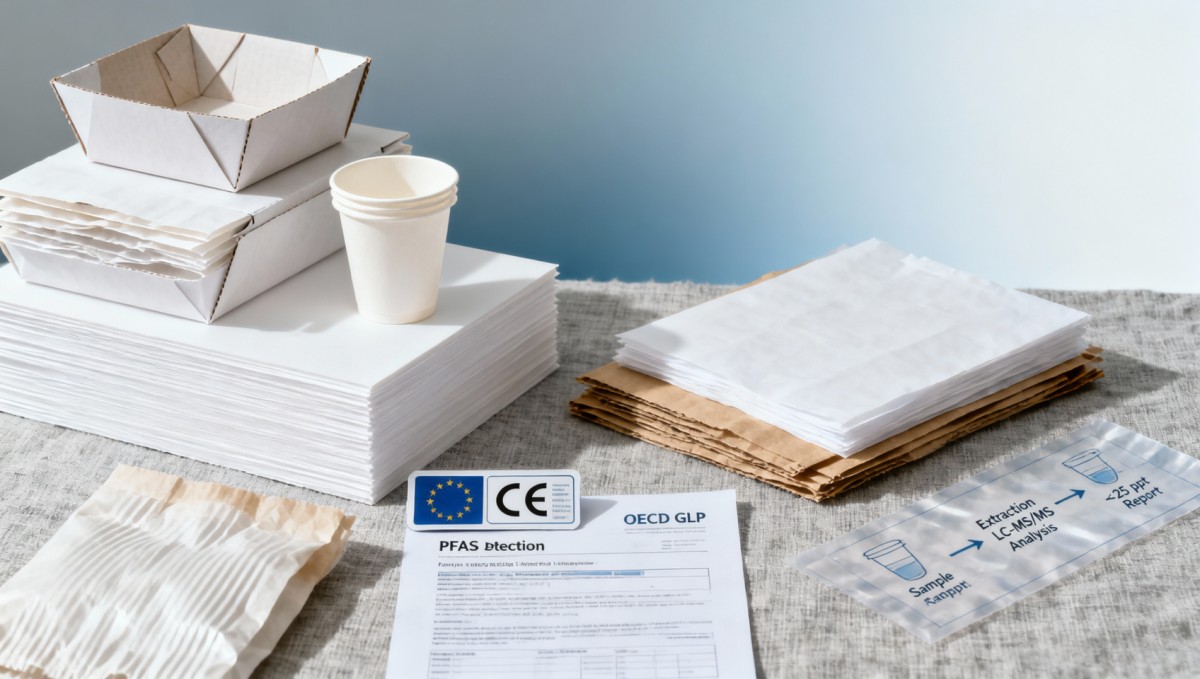
According to the European Commission’s 20 May 2024 update to the REACH Enforcement Project 2026–2027, all paper-based packaging entering the EU market — including corrugated boxes, food-contact paper, and shipping label stock — will be subject to mandatory PFAS screening at EU borders effective 1 June 2026. Exporters must submit PFAS content test reports, issued by OECD GLP-accredited laboratories, confirming levels at or below 25 parts per trillion (ppt), prior to shipment. The measure has already prompted several major European retailers to revise procurement terms with non-EU suppliers.
Industries Affected
Direct trading enterprises — primarily Chinese export traders and cross-border e-commerce fulfillment providers — face heightened pre-shipment compliance burdens. Their role as contractual intermediaries means they bear responsibility for documentation validity, yet often lack direct control over upstream material sourcing or testing logistics. Delays in report submission or laboratory accreditation mismatches may trigger customs holds or rejection — directly impacting order fulfilment timelines and buyer trust.
Raw material procurement enterprises — including pulp suppliers, specialty coating agents importers, and fluorinated additive distributors — are exposed to upstream traceability risks. PFAS may enter the supply chain via recycled fiber (e.g., de-inked pulp contaminated with legacy fluorotelomer-based coatings) or functional additives used in barrier papers. These firms now need to verify supplier declarations and secure batch-level analytical data — not just declarations of conformity.
Processing and manufacturing enterprises — such as folding carton converters, corrugated box plants, and food-grade paper laminators — confront operational recalibration. Many rely on third-party coatings or laminates whose PFAS status is either undisclosed or outdated. Requalification of existing formulations, validation of alternative chemistries (e.g., silicones, bio-based polymers), and internal QC protocol upgrades are now urgent technical priorities — not optional enhancements.
Supply chain service enterprises — including freight forwarders, customs brokers, and compliance consultants — must expand service scope beyond traditional documentation handling. Demand is rising for integrated support: GLP lab coordination, REACH-compliant report review, EU importer liaison, and real-time regulatory interpretation. Firms without certified REACH expertise risk becoming bottlenecks rather than enablers.
Key Focus Areas and Response Measures
Validate laboratory accreditation rigorously
Not all GLP-certified labs meet OECD criteria for PFAS analysis in complex matrices like paper. Exporters must confirm that their chosen lab is accredited under ISO/IEC 17025 specifically for EPA Method 537.1 or equivalent, and that its scope explicitly covers paper substrates — not just water or soil.
Map PFAS exposure points across the value chain
Analysis shows PFAS presence is rarely due to intentional use alone; it often stems from recycled fiber contamination or equipment lubricants migrating during high-speed converting. Companies should conduct tiered material flow audits — starting from incoming pulp and coatings through finishing processes — to identify hidden sources before investing in costly reformulation.
Negotiate updated contractual terms with EU importers
Observably, many current supply agreements lack clauses assigning responsibility for PFAS testing costs, report ownership, or liability for non-compliance. Firms should proactively renegotiate terms to clarify who bears retesting costs, how report validity periods are defined (e.g., 90 days vs. per-batch), and whether ‘zero declaration’ remains acceptable post-2026.
Editorial Perspective / Industry Observation
This policy marks less a sudden departure than a formalization of enforcement trends already visible in national-level PFAS restrictions (e.g., Denmark’s 2023 food-contact ban, Germany’s draft packaging ordinance). From an industry perspective, the 25 ppt threshold aligns closely with emerging detection capabilities — suggesting the EU prioritizes enforceability over scientific conservatism. Current more critical concern lies not in the limit itself, but in the absence of harmonized analytical standards across member states: one lab’s ‘non-detect’ may differ materially from another’s due to matrix interference corrections or calibration approaches. That variability could become a source of trade friction — especially for SMEs lacking in-house analytical capacity.
Conclusion
The June 2026 PFAS screening requirement signals a structural tightening of chemical governance in EU packaging markets — one that rewards transparency, traceability, and technical preparedness over volume-driven export models. For Chinese manufacturers and traders, this is not merely a compliance checkpoint, but a catalyst accelerating the shift toward vertically integrated quality assurance systems and chemistry-aware sourcing strategies.
Source Attribution
European Commission, REACH Enforcement Project 2026–2027: Updated Priorities and Target Sectors, 20 May 2024 (Reference: EC/ENV/C/2024/087). Official notice accessible via the European Chemicals Agency (ECHA) Enforcement Forum portal. Note: Final testing methodology guidance and list of approved GLP labs remain pending publication; stakeholders are advised to monitor ECHA updates through Q4 2024.