products
‹
›
‹
›
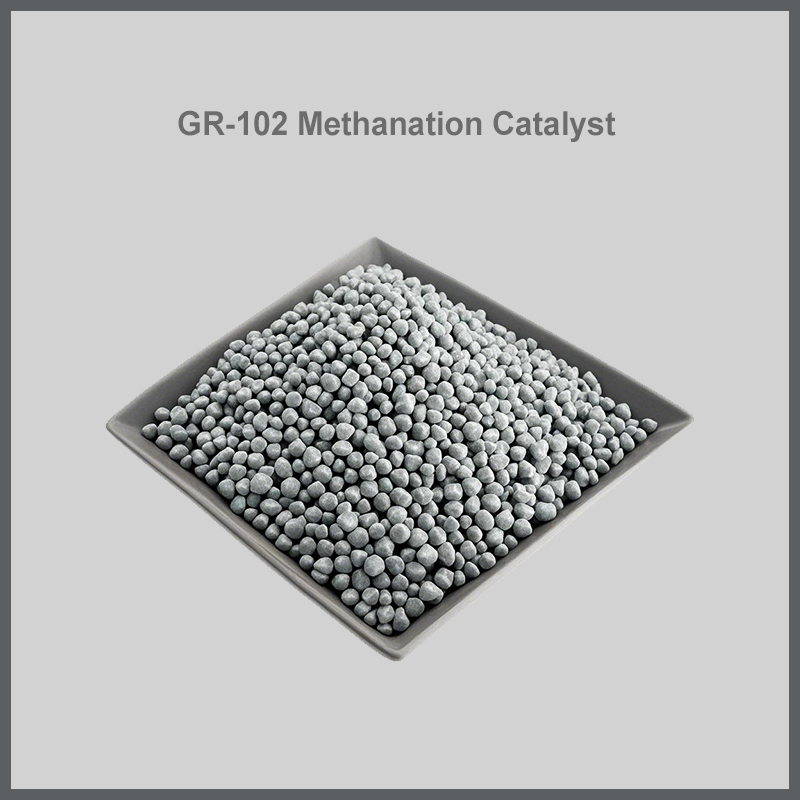
GR-102 Methanation Catalyst
This process not only effectively protects downstream catalysts, such as ammonia synthesis catalysts, from poisoning and deactivation, which are extremely sensitive to carbon oxides, but also ensures the purity of the final hydrogen and ammonia products. The GR-102 catalyst utilizes a highly active nickel-based component and a special support, resulting in high reactivity, excellent selectivity, high mechanical strength, and superior thermal stability.
Its greatest advantage lies in its exceptionally high purification precision, easily reducing the total carbon oxide (CO + CO₂) concentration in the outlet gas to below 10 ppm (parts per million),
Product Description
In hydrogen and ammonia production units, GR-102 methanation catalyst is used to promote the reaction of low-concentration carbon oxides(such asco, CO2)with excess hydrogen to generate inert gas cH4and easily removable H20, so as to purify the gases and protect the downstream catalyst. Methanation reaction is a convenient and economical method for gas purification, which can reduce carbon oxides to a low residual content of 10-6(v/v). The outlet co+co2of a properly designed and normally operated methanationreactorcanusuallybeeasilyreducedtobelow10×10-6(v/v),andtheservice life can reach more than5years in large-scale hydrogen and ammonia production units.

The reaction sasfollows
CO+3H22=CH4+H20
H0,298=-206.2 KJ/mol CO2+4H2=CH4+2HZ2 0
H0,298=-165.0KJ/mol
Product Parameters
FAQ
1.Why is a methanation catalyst essential in hydrogen production and ammonia synthesis?
Downstream precious metal catalysts or ammonia synthesis catalysts are extremely sensitive to trace amounts of CO and CO₂ in the feed gas. Even ppm-level residues can poison and permanently deactivate them. Methanation is the final, deep purification step to ensure feed gas purity.
2.How does the GR-102 catalyst reduce carbon oxides to below 10 ppm?
The catalyst boasts a high density of highly dispersed active sites and an optimized pore structure, ensuring extremely high intrinsic activity and excellent internal diffusion efficiency. This allows it to deeply promote the hydrogenation of trace amounts of CO and CO₂, achieving ppm-level purification accuracy.
3.Methanation is a highly exothermic reaction. How does the GR-102 catalyst address bed temperature rise?
The catalyst exhibits excellent thermal stability and sintering resistance. In process design, effective control of bed temperature rise is typically achieved by controlling the inlet carbon oxide concentration (generally <1.5%), employing multiple layers, and implementing chilling or indirect heat exchange to protect the catalyst and equipment.
4.What are the main factors affecting the service life of the GR-102 catalyst?
The main factors include the content of toxicants (such as sulfur, chlorine, and arsenic) in the feed gas, the range of operating temperature fluctuations, the frequency of starts and stops, and the number of times the catalyst must respond to unexpected operating conditions (such as "temperature runaway"). Maintaining feed purity and stable operation are key to extending the catalyst's service life.
5.Does the catalyst require reduction and activation before use?
Yes. The active component nickel in the GR-102 catalyst exists in an oxidized form (NiO). Before use, it must be reduced using hydrogen or a hydrogen-containing process gas at a certain temperature to convert it into catalytically active metallic nickel (Ni⁰).
Request a Quote
Related Recommendations