


BLOG
CONTENTS
- EU REACH Tightens NPEOs Limit for Paper ImportsAug 09, 2026
- EU Enforces NPEOs Ban on Coated Paper ImportsAug 08, 2026
- EU REACH Restriction on NPEOs in Paper Coatings Takes EffectAug 07, 2026
- EU REACH Tightens Paper Chemical Rules From Aug. 15Aug 06, 2026
- ECHA Adds 3 SVHCs, Exporters Recheck DeclarationsAug 05, 2026
ECHA PFAS Draft Raises New Bar for Paper Food Packaging
On July 22, 2026, ECHA submitted to the European Commission a draft restriction covering the full PFAS substance group through a proposed amendment to REACH Annex XVII. For exporters of paper-based food contact materials, this is not just a policy headline: it signals a compliance path change for products such as baking paper and fast-food wrapping paper, because intentionally added PFAS would be brought into the ban scope and supporting documentation would move closer to a pre-shipment and pre-clearance requirement.
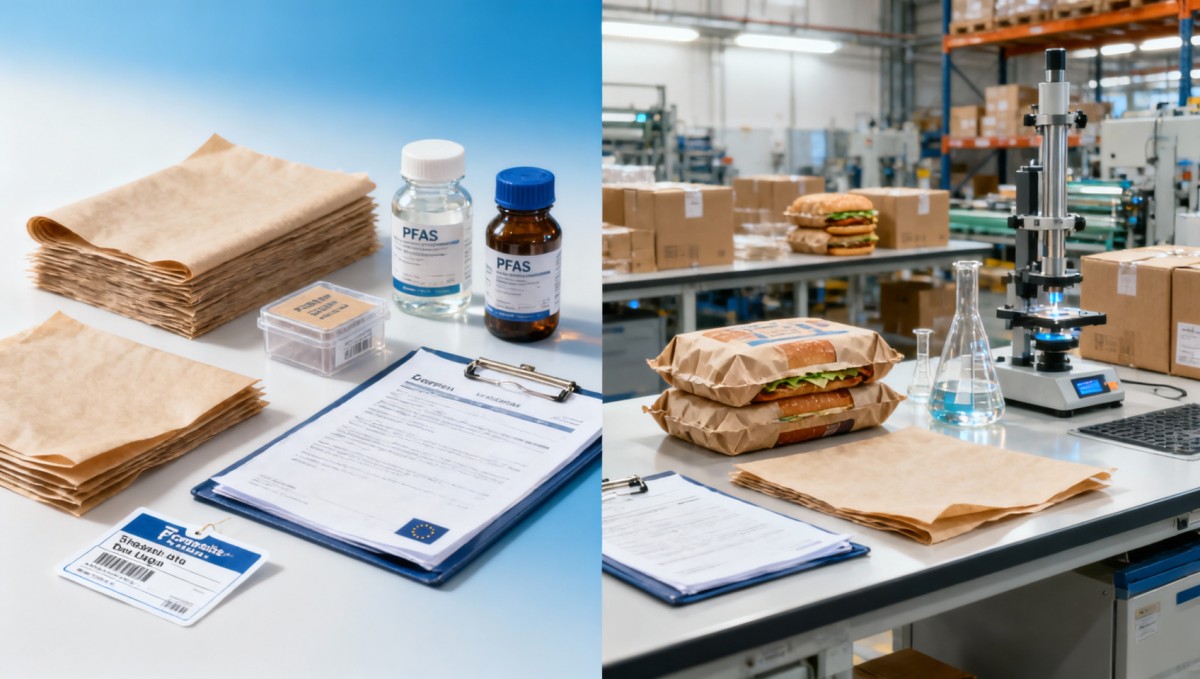
What the draft restriction now covers
According to the information provided, the draft was submitted by ECHA on July 22, 2026, to the European Commission as a PFAS group restriction proposal under a revision draft to REACH Annex XVII. The proposal, for the first time, brings all intentionally added PFAS in paper-based food contact materials into the prohibition scope, including products such as baking paper and fast-food packaging paper.
The information provided also states that the draft is expected to take effect in Q2 2027. It directly affects the compliance route for Chinese paper product exporters to the EU market. Suppliers would be required to provide third-party PFAS test reports and declarations on alternative processes, while importers would need to complete supply chain traceability filing before customs clearance.
Where the pressure will appear first in the supply chain
Formula and process decisions move upstream
From an industry perspective, manufacturers of paper-based food contact materials are likely to face the earliest adjustment pressure because the rule change is tied to intentionally added PFAS. The direct impact is likely to fall on formulation choice, process substitution, technical file preparation, and product release decisions. What deserves closer attention is whether existing export-oriented products still rely on fluorinated functions that would conflict with the proposed restriction scope.
Procurement teams will need stronger document control
For raw material procurement and sourcing functions, the issue is no longer limited to price and delivery. Analysis shows that procurement teams may need to verify whether suppliers can provide PFAS third-party test reports and alternative process declarations in a form usable for downstream compliance review. This can affect supplier qualification, incoming material review, and purchase scheduling for EU-bound orders.
Export and customs-facing workflows become more document-driven
For exporters, traders, and supply chain service providers handling EU shipments, the rule change points to a tighter connection between compliance records and customs readiness. Based on the provided information, importers must complete supply chain traceability filing before customs clearance. That means documentation quality, traceability consistency, and coordination between supplier files and importer records could become practical checkpoints in shipment execution.
Testing and compliance support functions may see earlier involvement
Testing service providers and compliance support teams may become involved earlier in project timelines because the required third-party PFAS reports are identified in the provided summary as part of the compliance route. Observably, this shifts some work from reactive proof after shipment planning to earlier technical verification before export documentation is finalized.
What companies should review now
Check whether EU-bound paper food contact products still depend on PFAS
Analysis shows that companies supplying baking paper, fast-food wrapping paper, or similar paper-based food contact materials should first review whether intentionally added PFAS remain in current formulations or production processes. The practical significance is not only product legality after the expected effective date, but also whether transition work needs to start before customer orders and delivery commitments are affected.
Prepare test reports and process declarations as trade documents
What deserves closer attention is the documentary side of compliance. The provided information specifically mentions third-party PFAS test reports and declarations on alternative processes. Companies may therefore need to treat these not only as technical records, but also as documents that could influence order confirmation, customer review, and shipment release for EU business.
Review traceability readiness with import-side partners
The requirement for importers to complete supply chain traceability filing before customs clearance suggests that exporters should not view compliance as a factory-only matter. Observably, coordination with importers and supply chain partners may become more important in mapping product origin, material inputs, and supporting files so that traceability records can be aligned before goods reach the clearance stage.
Watch for the next layer of execution detail
The information provided does not include detailed enforcement language, document format rules, or operational guidance. For that reason, companies should closely monitor how the proposal is later expressed in official wording, compliance interpretation, procurement specifications, customer requirements, and tender or contract documents. At this stage, it would be premature to treat those details as settled outcomes.
How this should be read at the current stage
Analysis shows that this development is best understood as a strong execution signal rather than a fully closed enforcement picture. The proposal has already identified the direction of control: intentionally added PFAS in paper-based food contact materials, supporting third-party testing, alternative process declarations, and importer-side traceability filing. At the same time, the market still needs to observe how the draft moves through formal adoption and how downstream compliance practice will interpret the documentation burden.
From an industry perspective, the immediate value of this update is that it narrows the room for delay in product transition planning. It is more appropriate to understand this as a rule dynamic with practical preparatory consequences, especially for suppliers already serving EU-bound food packaging business.
A compliance signal that reaches beyond the factory floor
For the paper-based food contact materials trade, this update matters because it links material composition, technical substantiation, and customs-facing traceability into one compliance chain. The issue is not limited to whether a product contains intentionally added PFAS; it also touches how exporters, suppliers, and importers prove that point in a way that can support market access.
At the current stage, it is more appropriate to read this development as an approaching compliance threshold with clear preparation value, rather than as a completed enforcement result. The practical question for companies is how early they can align formulations, test records, declarations, and traceability files before the expected Q2 2027 effective timeline begins to influence orders and delivery arrangements.
Basis of this article and what still needs verification
This article is generated based on the user-provided news title, event date, and event summary. For events of this kind, relevant source types typically include official notices, releases from regulatory authorities, customs or trade administration information, industry association updates, standards-related documents, and reporting by authoritative media.
No specific official source link was provided in the input, so the official link and later document versions still need to be verified on an ongoing basis. Further observation is also needed on detailed policy wording, certification and compliance interpretation, changes in tender or procurement documents, industry feedback, and how companies implement traceability and document preparation in practice.