


CONTENTS
- Brazil Mulls Doubling Tariffs on Low-Cost Paper ImportsAug 17, 2026
- China’s Paper Industry to Join Carbon Market in Phases, Raising Export Compliance PressureAug 16, 2026
- China’s Paper Sector to Enter the National Carbon Market in 2026, Raising Export Compliance PressureAug 15, 2026
- China Paper Exports Jump 92.5% in Jan-MayAug 14, 2026
- The EU's PPWR enters into force today, raising compliance thresholds for paper-based packaging exported to the EU.Aug 13, 2026
2026 Hotel Napkin Upgrade: Premium Customization, Reinforced Softness & Eco-Antimicrobial Standards Raise Global Sourcing Bar
Global hotel procurement standards for napkins are undergoing a structural shift — beginning in late 2025 and accelerating through 2026 — driven by rising guest expectations, sustainability mandates, and hygiene accountability across luxury hospitality markets. This evolution directly impacts manufacturers, traders, raw material suppliers, and logistics service providers engaged in the international tissue supply chain.
Event Overview
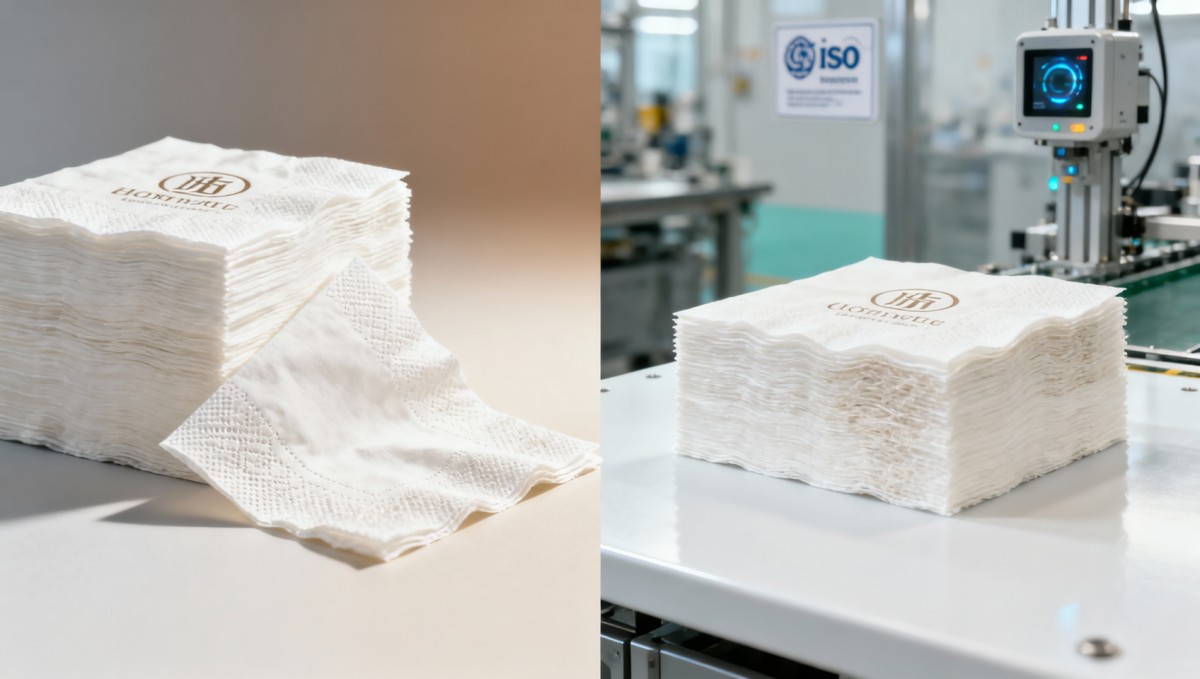
From 2025–2026, leading hotel groups in Europe, North America, the Middle East, and Southeast Asia have introduced mandatory napkin specifications for new supplier onboarding and contract renewals. These include: wet tensile strength retention ≥85%, food-grade virgin wood pulp certification, third-party antimicrobial testing per ISO 22196, and on-demand brand customization (e.g., embossed logos, multilingual compliant labeling). Five major Chinese manufacturing hubs — located in Shandong, Jiangsu, Guangdong, Zhejiang, and Fujian — have confirmed full compliance across production, quality control, and documentation systems. Lead times for certified orders now average 12 days; minimum order quantities (MOQs) have been reduced to 500 boxes, with multilingual regulatory labeling support included.
Industries Affected
Direct Trading Enterprises
Trading firms acting as intermediaries between Chinese factories and overseas hotel chains face intensified due diligence requirements. Buyers now demand full traceability dossiers — including pulp origin certificates, lab reports, and print-proof approvals — prior to PO issuance. Non-compliant traders risk exclusion from RFPs issued by Marriott International, Accor’s premium brands (e.g., Sofitel, Pullman), and Dubai-based Jumeirah Group. Margin compression is observed where re-labeling or secondary packaging is outsourced without integrated certification oversight.
Raw Material Procurement Enterprises
Suppliers of pulp, wet-strength resins, and antimicrobial additives must now provide batch-level documentation aligned with food-contact and ISO 22196 test protocols. Increased demand for certified FSC/PEFC virgin pulp — particularly bleached softwood kraft — has tightened regional availability and raised input costs by an estimated 7–12% year-on-year. Suppliers lacking audit-ready chain-of-custody records face delayed qualification cycles or outright rejection by downstream converters.
Processing & Manufacturing Enterprises
Factories previously focused on bulk commodity napkins must invest in upgraded creping, embossing, and printing lines capable of handling low-MOQ, high-variability runs without compromising wet strength or ink adhesion. Quality assurance systems now require in-line wet tensile monitoring and quarterly ISO 22196 retesting. Those unable to demonstrate end-to-end process validation (e.g., pulp → sheet → printing → packaging) report declining win rates in Tier-1 hotel tenders.
Supply Chain Service Providers
Logistics and compliance service providers are seeing growing demand for integrated offerings: pre-shipment antimicrobial verification, multilingual label compliance checks (e.g., EU Regulation (EC) No 1935/2004, UAE ESMA labeling rules), and customs classification support under HS 4803. Standalone freight forwarders without tissue-specific regulatory expertise report longer document clearance times and higher correction fees at key ports including Rotterdam, Jebel Ali, and Singapore.
Key Focus Areas & Recommended Actions
Verify and Document Full Material Traceability
Enterprises must map pulp sourcing back to certified forests or sustainable plantations and retain batch-level test reports for every production run — not just annual certifications. Retrospective audits by hotel procurement teams now routinely request 12-month traceability logs.
Invest in Modular Printing & Small-Batch Flexibility
Supporting MOQs as low as 500 boxes requires digital or hybrid flexo-digital printing capability and agile inventory management. Factories retaining legacy offset-only lines report 30–45-day delays when accommodating urgent custom requests — a critical gap against the 12-day delivery benchmark.
Align Lab Testing Protocols with ISO 22196 Requirements
Not all antimicrobial claims are equivalent. Third-party labs must be accredited for ISO 22196 (measuring antibacterial activity on plastics and other non-porous surfaces); generic ‘antibacterial’ certificates or internal test data are no longer accepted. Pre-certified labs in China (e.g., SGS Shanghai, CTI Shenzhen) now offer expedited turnaround (≤5 working days).
Standardize Multilingual Label Compliance Frameworks
Labels must meet jurisdiction-specific requirements: EN 13432 for compostability claims in EU markets; UAE ESMA Annex 1 formatting rules; and FDA 21 CFR Part 176.170 for indirect food contact in the US. Generic bilingual (EN/CN) labels do not satisfy these — each target market requires dedicated artwork validation.
Editorial Perspective / Industry Observation
Observably, this napkin specification shift is not merely a product upgrade — it reflects a broader recalibration of how global hospitality defines ‘supply chain responsibility’. Where past procurement emphasized cost and consistency, current criteria embed environmental stewardship, microbiological safety, and brand co-creation into baseline technical requirements. Analysis shows that early adopters among Chinese manufacturers are shifting from ‘supplier’ to ‘solution partner’ positioning — bundling certification support, design consultation, and regulatory intelligence into commercial offers. That said, the pace of change may outstrip capacity in mid-tier facilities lacking capital for line modernization or international accreditation. Current more critical concern is not adoption feasibility, but verification scalability: as more buyers require real-time access to lab reports and pulp certifications, interoperable digital documentation platforms remain underdeveloped.
Conclusion
This evolution signals a maturing of the global tissue export ecosystem — one where technical compliance is no longer a differentiator, but a prerequisite for market access. For industry participants, the 2026 napkin standard serves less as a discrete regulation and more as a litmus test of operational readiness across sustainability, quality infrastructure, and customer-centric agility. A rational interpretation is that similar thresholds will likely extend to guest towels, bathrobes, and F&B service linens within 12–18 months.
Source Attribution
Information compiled from supplier qualification bulletins issued by Marriott International (Q4 2025), Accor Procurement Policy Update v3.1 (Jan 2026), Jumeirah Group Supplier Code of Conduct Addendum (Feb 2026), and factory capability assessments conducted by China Paper Association’s Export Certification Division (March 2026). Note: Specific enforcement timelines for Tier-2 and Tier-3 hotel operators remain unannounced and are under continuous monitoring.