


BLOG
CONTENTS
- Brazil Mulls Doubling Tariffs on Low-Cost Paper ImportsAug 17, 2026
- China’s Paper Industry to Join Carbon Market in Phases, Raising Export Compliance PressureAug 16, 2026
- China’s Paper Sector to Enter the National Carbon Market in 2026, Raising Export Compliance PressureAug 15, 2026
- China Paper Exports Jump 92.5% in Jan-MayAug 14, 2026
- The EU's PPWR enters into force today, raising compliance thresholds for paper-based packaging exported to the EU.Aug 13, 2026
New Paper Yellowing Within 24 Hours: Oxidation, Acidity, Light
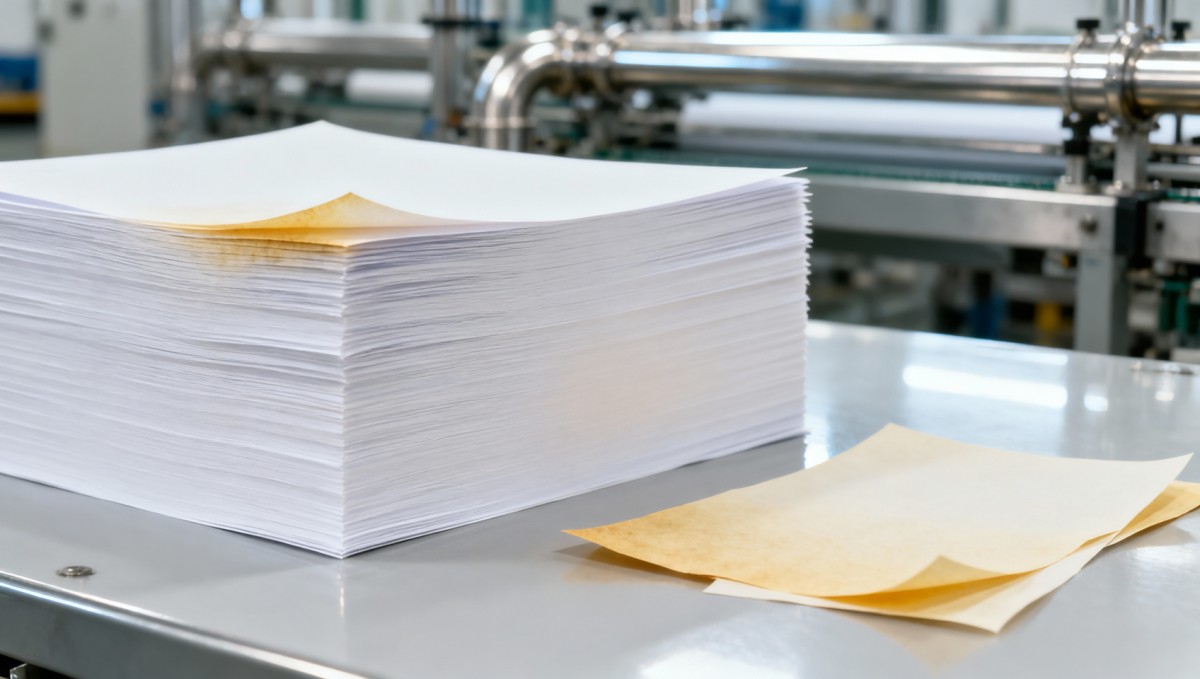
On March 16, 2026, a leading industry analysis revealed that newly manufactured paper can yellow within 24 hours due to oxidation, residual acidity (e.g., from sulfate pulping), and exposure to UV/IR radiation. This rapid discoloration directly affects durability, whiteness stability, and international buyers’ assessments of shelf life and storage compliance—particularly for exporters targeting markets with strict archival and colorfastness standards, including the EU, US, Japan, and South Korea.
Event Overview
On March 16, 2026, authoritative industry analysis identified three primary causes of accelerated yellowing in fresh paper: oxidative reactions, acidic conditions (such as residual sulfuric acid from sulfate-based pulping), and exposure to ultraviolet or infrared light. These factors collectively compromise paper’s whiteness retention and long-term stability. The finding is linked to international compliance frameworks—including ISO 9706 and ANSI/NISO Z39.48—and highlights implications for export readiness, warehouse protocols, and packaging specifications.
Industries Affected
Export Trading Companies
These firms face heightened scrutiny from overseas buyers who require documented evidence of pH neutrality, light-resistant packaging, and controlled logistics environments. Non-compliance may trigger rejections, extended inspection cycles, or contractual renegotiations—especially under procurement clauses referencing ISO 9706 or ANSI/NISO Z39.48.
Paper Manufacturers & Converters
Producers using sulfate pulping or lacking post-process neutralization steps risk failing incoming quality audits from international clients. Yellowing observed within 24 hours signals potential non-conformance with archival-grade benchmarks—even if final product meets basic brightness specs.
Logistics & Warehousing Providers
Storage facilities handling export-bound paper must now verify ambient UV exposure levels, humidity control (targeting 45–55% RH), and temperature consistency. Uncontrolled lighting or ventilation systems emitting UV/IR radiation may contribute to pre-shipment degradation—raising liability questions in supply chain agreements.
Suppliers to Archival, Publishing & Packaging Sectors
Businesses serving libraries, museums, high-end print publishers, or pharmaceutical packaging clients are especially exposed: yellowing undermines claims of ‘acid-free’ or ‘lignin-free’ performance. Buyers in these segments increasingly request third-party pH testing reports and accelerated aging data—not just initial brightness values.
What Enterprises Should Monitor & Do Now
Verify current pulp processing parameters against pH neutrality benchmarks
Manufacturers should audit whether residual acidity from sulfate pulping is fully neutralized post-bleaching. Export-oriented lines may need to adopt calcium carbonate buffering or switch to ECF/TCF bleaching where technically feasible—without assuming existing process controls meet evolving buyer expectations.
Review packaging specifications for UV-blocking capability
Overseas buyers are increasingly specifying packaging materials with UV-absorbing additives or aluminum-laminated layers. Traders and converters should assess whether current wrapping films, cartons, or pallet covers provide measurable attenuation of wavelengths below 400 nm—and document test results for client review.
Evaluate warehouse and transport conditions for spectral exposure risks
Facilities using fluorescent or LED lighting with unfiltered UV emission—or relying on skylights without UV-cut glazing—may inadvertently accelerate yellowing. A low-cost diagnostic step: conduct spectroradiometric spot checks at storage locations where paper is held >12 hours before shipment.
Prepare technical documentation aligned with ISO 9706 and ANSI/NISO Z39.48
Instead of generic ‘archival-grade’ claims, suppliers should compile test reports covering pH measurement (per ISO 6588-1), alkaline reserve (per TAPPI T 435), and accelerated aging (per ISO 18902). Proactive submission of such dossiers supports faster buyer qualification—particularly for repeat orders in regulated verticals.
Editorial Observation / Industry Perspective
Observably, this finding functions less as an isolated incident and more as a signal of tightening technical convergence between paper manufacturing practice and end-use compliance frameworks. Analysis shows it reflects growing alignment among international buyers—not only on aesthetics (whiteness) but on verifiable process traceability (e.g., pH logs, spectral shielding validation). From an industry perspective, it is not yet a regulatory enforcement action, but rather a de facto benchmark shift driven by procurement-led standard adoption. Current relevance lies in its role as an early indicator: markets requiring archival durability are no longer accepting ‘as-manufactured’ paper as inherently stable. Instead, stability is now treated as a function of integrated process control, packaging integrity, and environmental management across the full handover chain—from mill to shelf.
Conclusion: This insight underscores that paper yellowing within 24 hours is not merely a quality anomaly—it is a systems-level indicator affecting export viability, buyer trust, and logistical design. It is best understood not as a new problem, but as newly quantified evidence of longstanding gaps between traditional production assumptions and internationally recognized durability requirements. Enterprises engaged in cross-border paper trade or high-specification conversion should treat it as a prompt for cross-functional alignment—not just QA review, but joint assessment across R&D, packaging engineering, logistics planning, and technical sales.
Source: Authoritative industry analysis published March 16, 2026. No further official updates or policy announcements have been confirmed as of publication. Ongoing observation is recommended regarding buyer-facing specification revisions in major import markets, particularly EU CE marking guidance updates or U.S. Library of Congress procurement notices.