


CONTENTS
- Brazil Mulls Doubling Tariffs on Low-Cost Paper ImportsAug 17, 2026
- China’s Paper Industry to Join Carbon Market in Phases, Raising Export Compliance PressureAug 16, 2026
- China’s Paper Sector to Enter the National Carbon Market in 2026, Raising Export Compliance PressureAug 15, 2026
- China Paper Exports Jump 92.5% in Jan-MayAug 14, 2026
- The EU's PPWR enters into force today, raising compliance thresholds for paper-based packaging exported to the EU.Aug 13, 2026
New Paper Turns Yellow in 24 Hours: Oxidation, Acidity, UV Exposure Emerge as Key Compliance Risks for Imports
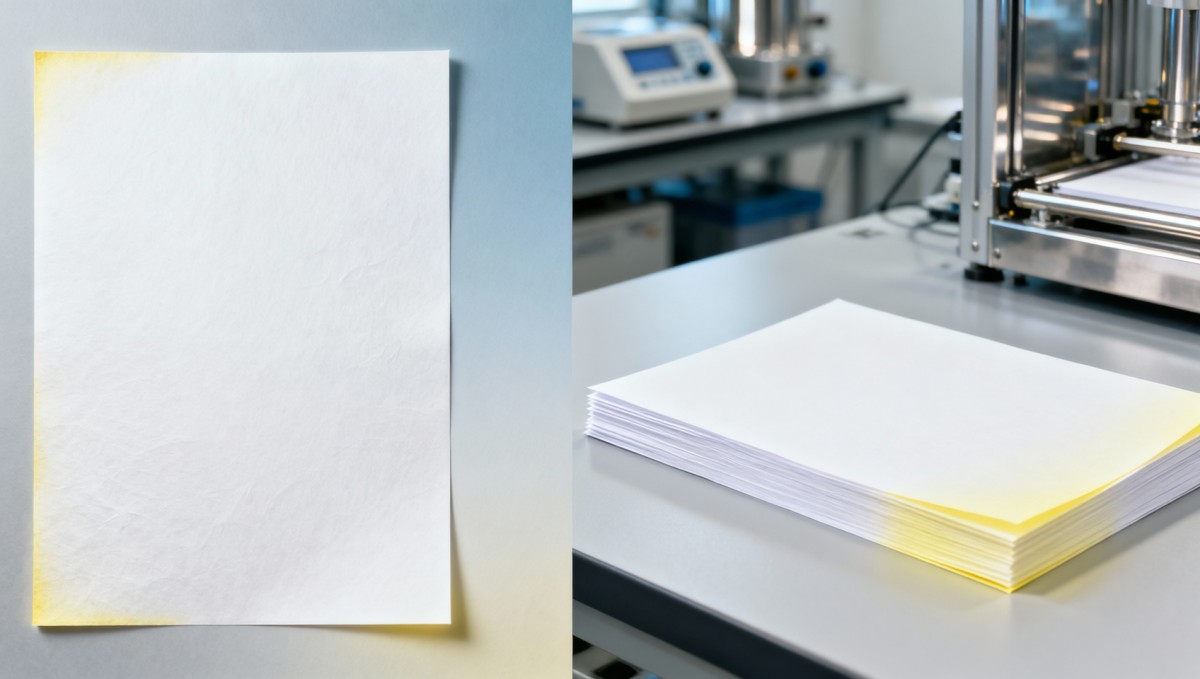
Recent findings released on March 16, 2026, by authoritative industry analysts have identified rapid yellowing of fresh paper within 24 hours as a critical material stability issue—driven primarily by lignin oxidation, acidic hydrolysis, and UV-catalyzed degradation. This phenomenon poses immediate implications for global paper exporters, especially those targeting markets with stringent regulatory frameworks governing paper pH, residual lignin content, and photostability—including the EU, U.S., Japan, South Korea, and select Middle Eastern countries.
Event Overview
On March 16, 2026, an authoritative industry analysis confirmed that newly manufactured paper can exhibit visible yellowing within 24 hours under ambient storage conditions. The root causes are threefold: (1) oxidative degradation of lignin; (2) acid-catalyzed hydrolysis of cellulose chains; and (3) ultraviolet light–accelerated photochemical reactions. These mechanisms collectively compromise color stability, mechanical integrity over time, and long-term archival performance. The analysis explicitly links this behavior to non-compliance risks under ISO 9706 (permanent paper), EN 13432 (compostable packaging), and ASTM D6868 (biobased labeling), particularly where visual appearance or pH thresholds are enforced during customs clearance or end-user acceptance.
Industries Affected
Direct Trading Enterprises
Export-oriented trading firms face heightened rejection and return exposure—especially when shipping hotel tissue, food-grade wrapping paper, or premium offset printing stock to regulated markets. Since aesthetic conformity is often contractually binding and subject to pre-shipment inspection, unexpected yellowing may trigger disputes, penalty clauses, or loss of certification status under buyer-specific quality protocols.
Raw Material Procurement Entities
Suppliers sourcing pulp, filler additives, or sizing agents must now reassess vendor specifications for lignin content, buffering capacity (e.g., calcium carbonate loading), and UV-absorber compatibility. Observably, procurement teams are increasingly requesting third-party test reports covering accelerated aging (ISO 2470-2) and pH profiling—not just initial batch compliance—as part of supplier qualification.
Processing & Manufacturing Firms
Converters and finishers—including those producing laminated food packaging or embossed stationery—report increased post-conversion discoloration when using untreated or low-buffered base stocks. Analysis shows that finishing processes such as calendaring or coating can inadvertently accelerate surface oxidation if ambient lighting or storage humidity is uncontrolled, making process validation more complex.
Supply Chain Service Providers
Logistics and warehousing operators serving export clients are revising handling guidelines: UV-filtered storage zones, climate-controlled staging areas (
Key Considerations and Recommended Actions
Conduct Accelerated Aging Validation Under Target Market Conditions
Testing should replicate actual destination environments—not just lab-standard conditions. For example, Middle Eastern shipments require combined high-UV + high-humidity cycling; EU-bound consignments demand strict pH drift monitoring over 7-day simulated shelf life.
Re-evaluate Pulp Sourcing and Alkaline Reserve Specifications
Procurement teams should prioritize pulps certified to ISO 9706 Annex A (alkaline reserve ≥ 2% CaCO₃ equivalent) and verify lignin removal efficiency via Klason lignin assays—not solely brightness metrics.
Update Quality Agreements with Downstream Buyers
Contracts should explicitly define acceptable yellowing thresholds (e.g., Δb* ≤ +1.5 after 24h per ISO 2470-2), specify storage condition liabilities, and clarify responsibility for rework or replacement if discoloration occurs post-shipment but pre-acceptance.
Editorial Insight / Industry Observation
This finding does not signal a new chemical hazard—but rather exposes a latent gap between traditional paper quality benchmarks (e.g., brightness, tensile strength) and emerging functional requirements tied to visual permanence and regulatory traceability. Current more relevant framing is: yellowing is no longer a cosmetic concern, but a proxy indicator for underlying instability that correlates with broader compliance failure modes. Observably, early adopters are integrating real-time spectral monitoring at production line exits—not for grading, but for predictive nonconformance alerts.
Conclusion
The 24-hour yellowing phenomenon underscores how subtle physicochemical interactions—once overlooked in routine QC—can rapidly escalate into cross-border trade barriers. Rather than representing a temporary technical anomaly, it reflects tightening convergence between sustainability standards (e.g., EN 13432), archival mandates (ISO 9706), and consumer-facing aesthetics. A rational interpretation is that paper supply chains are entering a phase where ‘stability-by-design’ must replace ‘stability-by-assumption’.
Source Attribution
Primary source: Authoritative industry analysis published March 16, 2026, referencing ISO 9706:2016, EN 13432:2000/A2:2018, and ASTM D6868–22. Ongoing verification of field-reported incidents is coordinated through the International Paper Trade Association (IPTA) Technical Compliance Working Group—status updates to be tracked quarterly.