


BLOG
CONTENTS
- Brazil Mulls Doubling Tariffs on Low-Cost Paper ImportsAug 17, 2026
- China’s Paper Industry to Join Carbon Market in Phases, Raising Export Compliance PressureAug 16, 2026
- China’s Paper Sector to Enter the National Carbon Market in 2026, Raising Export Compliance PressureAug 15, 2026
- China Paper Exports Jump 92.5% in Jan-MayAug 14, 2026
- 欧盟PPWR今日生效,输欧纸基包装合规门槛抬升Aug 13, 2026
China Customs Adds REACH SVHC Filing for EU Paper Exports
From August 1, 2026, China Customs will require exporters shipping paper and paper products to the EU to submit an SVHC declaration aligned with EU REACH at the time of customs declaration, together with a conformity document issued by a CMA-qualified third-party laboratory. The requirement covers paper categories including packaging paper, cultural paper, and specialty paper. For exporters, importers, and supply chain service providers handling EU-bound shipments, the change merits close attention because it links customs filing in China with downstream clearance efficiency and compliance exposure at EU ports.
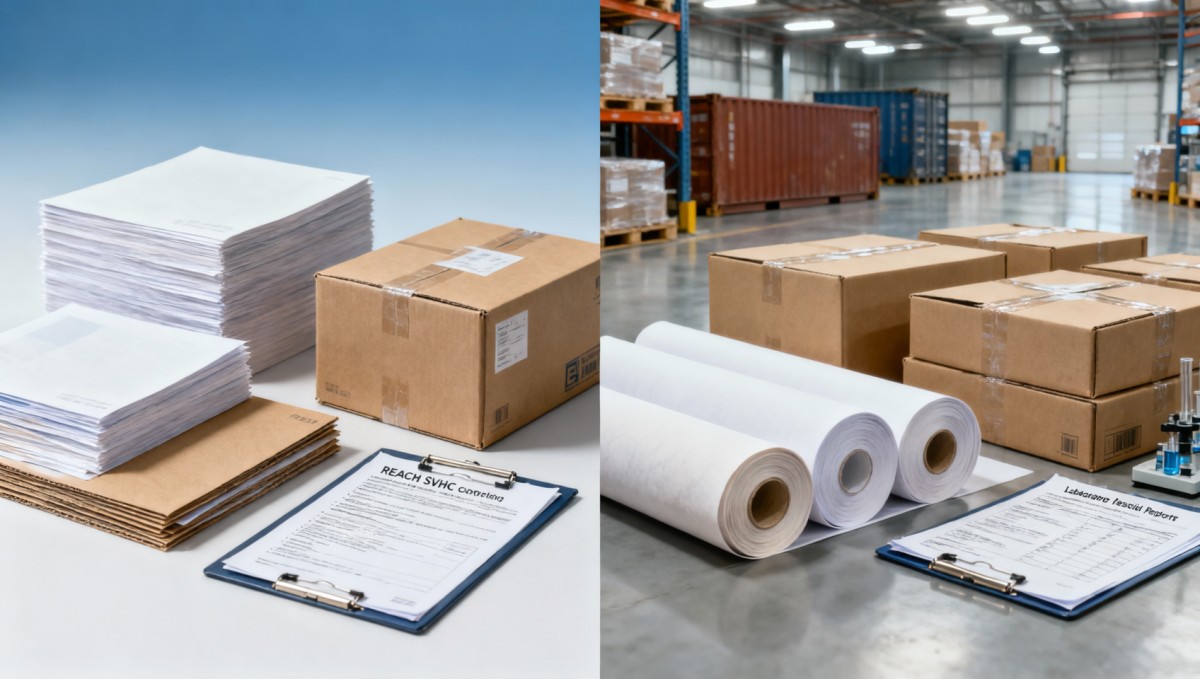
What the new filing requirement covers
The confirmed change takes effect on August 1, 2026 and applies to paper and paper products exported from China to the European Union, including packaging paper, cultural paper, and specialty paper. Under the new requirement, the export customs declaration must be accompanied by an SVHC declaration that complies with EU REACH, as well as proof of conformity issued by a CMA-qualified third-party laboratory.
The event summary also states that the measure directly affects customs clearance timing and compliance costs for overseas importers. Where a valid declaration is not provided, goods may face return or detention at EU ports.
Where the immediate pressure is likely to appear
Export filing moves closer to product compliance
Direct trading companies shipping paper products to the EU are likely to feel the first impact because the new requirement applies at the export declaration stage. Their operational focus will shift from preparing standard shipping documents alone to ensuring that the required SVHC declaration and third-party conformity proof are available in time for customs filing.
Manufacturing and converting businesses may face document coordination demands
Paper manufacturers and processors involved in packaging paper, cultural paper, and specialty paper may be affected because product-related compliance materials will now influence export release and downstream entry into the EU. The practical pressure point is less about general production activity and more about whether documentation can match specific export batches and customer delivery schedules.
Overseas importers face clearance and cost exposure
The event summary makes clear that overseas importers may see direct effects on customs clearance timing and compliance costs. That means import-side planning, especially for time-sensitive shipments, may depend more heavily on whether exporters have completed the required declaration and obtained valid third-party proof before cargo reaches the EU.
Logistics and customs service providers may need tighter handoff control
From an industry perspective, freight forwarders, customs brokers, and related service providers may also be affected because document completeness becomes more critical to shipment flow. The key change to watch is whether the handoff between exporter, laboratory, and customs filing party is managed early enough to avoid delays caused by missing or invalid paperwork.
What companies should watch now
Whether documentation can be prepared before declaration deadlines
What deserves closer attention is the timing relationship between export booking, customs declaration, and the issuance of conformity proof by a CMA-qualified third-party laboratory. For businesses shipping regularly to the EU, document readiness may become a scheduling issue rather than only a compliance issue.
Which product lines are exposed first
Companies handling packaging paper, cultural paper, and specialty paper should review which EU-bound product lines fall within the scope described in the event summary. In practice, attention is likely to concentrate on shipments with tight delivery commitments or customers that are sensitive to customs clearance delays.
How exporter and importer communication is handled
Because the measure directly affects overseas importers' clearance timing and compliance costs, exporters may need to communicate more clearly with EU customers about declaration status, supporting documents, and delivery risks if paperwork is incomplete. This is especially relevant where importers are relying on predictable port release timing.
Whether further official wording changes appear
Observably, businesses should continue monitoring whether additional official explanations, implementation details, or procedural clarifications emerge after the effective date. The current confirmed facts establish the filing requirement, but day-to-day execution often depends on how customs practice and document review are applied in actual shipments.
Why this matters beyond a single filing step
Analysis shows that this is more than a routine paperwork adjustment. It connects export declaration in China with EU-side compliance expectations in a more direct way for paper products. That does not by itself prove a broad structural shift across all materials or sectors, but it does indicate that documentation quality and third-party verification may play a more immediate role in shipment execution for EU-bound paper trade.
It is more appropriate to understand this as a concrete operational change with wider signaling value. The confirmed outcome is the new filing requirement itself; the broader industry effect still needs to be observed through implementation, clearance practice, and how consistently market participants can meet the new documentation standard.
How to read the signal at this stage
At this stage, the most reasonable reading is that the new requirement creates a near-term compliance and delivery management issue for exporters, importers, and service providers involved in EU-bound paper shipments. The significance lies in the fact that missing documentation may now translate into cargo detention or return at EU ports, while complete documentation may become a prerequisite for smoother cross-border execution.
From an industry perspective, this should be treated neither as a minor administrative detail nor as a basis for sweeping conclusions. It is a specific rule change with immediate operational consequences, and its longer-term meaning will depend on how the requirement is enforced and absorbed across the paper export supply chain.
Basis of this report and points for continued verification
This article is based on the user-provided news title, event date, and event summary. For developments of this type, relevant source categories usually include official notices, company announcements, industry association updates, authoritative media reports, and standard or regulatory documents. A specific official source link was not provided in the input, so continued verification remains necessary.
Further attention should remain on any later official clarification of filing practice, document requirements, and implementation details affecting EU-bound exports of packaging paper, cultural paper, and specialty paper.