


BLOG
CONTENTS
- Brazil Mulls Doubling Tariffs on Low-Cost Paper ImportsAug 17, 2026
- China’s Paper Industry to Join Carbon Market in Phases, Raising Export Compliance PressureAug 16, 2026
- China’s Paper Sector to Enter the National Carbon Market in 2026, Raising Export Compliance PressureAug 15, 2026
- China Paper Exports Jump 92.5% in Jan-MayAug 14, 2026
- 欧盟PPWR今日生效,输欧纸基包装合规门槛抬升Aug 13, 2026
China Requires PFAS Declarations for Paper Exports
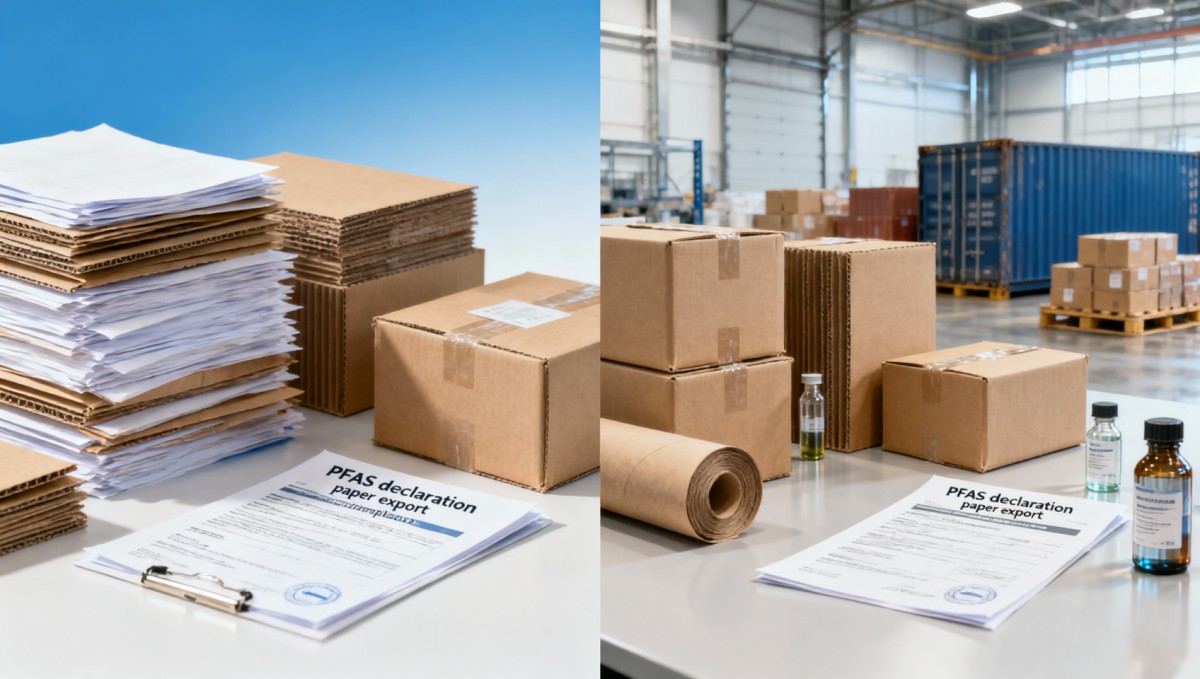
Effective August 1, 2026, China’s General Administration of Customs has introduced a new export control requirement for paper, paperboard, and paper-based packaging products: shipments must be accompanied by a PFAS testing declaration issued by a CNAS-accredited laboratory, or they will not be released. For exporters, overseas importers, distributors, and brand owners, this is a compliance development with immediate operational relevance because it directly affects document readiness, supplier review, and cross-border coordination ahead of the EU REACH Annex XVII limits becoming mandatory on August 15.
A New Documentation Gate for Paper and Paper-Based Exports
According to the information provided, China’s General Administration of Customs put into effect a supplementary guidance on strengthened export supervision of fluorinated compounds on August 1, 2026. Under this requirement, all exported paper, paperboard, and paper-based packaging products must carry a PFAS testing declaration issued by a CNAS-accredited laboratory.
The same information states that cargo without this declaration will not be cleared for release. The measure is described as a direct response to the newly added limit requirements under EU REACH Annex XVII, which will become mandatory on August 15. Its stated purpose is to reduce the risk of customs rejection and returned goods.
Where the Immediate Pressure Will Be Felt
Exporters face a tighter document preparation window
From an industry perspective, direct trading companies are likely to feel the first impact in shipment preparation. The requirement turns PFAS documentation into a release condition, which means paperwork timing becomes part of export execution rather than a follow-up compliance step. What deserves closer attention is whether existing order schedules leave enough time for testing declarations to be prepared before cargo handover and customs filing.
Importers and distributors may need deeper supplier checks
For overseas importers and distribution businesses, the change is relevant because supplier qualification can no longer focus only on product availability and pricing. Analysis shows that supplier review may now need to include whether the exporter can consistently provide PFAS declarations from CNAS-accredited laboratories, especially for paper-based goods moving toward markets affected by the EU rule change.
Brand owners may see more coordination work across sourcing and compliance
For brand owners using paper-based packaging, the issue is less about customs procedure alone and more about upstream alignment. Observably, this kind of requirement can affect how sourcing teams, packaging teams, and compliance functions exchange documents and confirm supplier readiness. The practical pressure point is coordination efficiency, particularly where multiple suppliers or repeated purchase cycles are involved.
Supply chain service providers may need to adjust file control processes
Logistics coordinators, documentation teams, and other supply chain service providers may also be affected because shipment release now depends on the presence of a specific compliance statement. The main concern is not a new commercial obligation in itself, but the risk of delay if file collection, document verification, or handoff procedures are not updated in time.
What Companies Should Be Watching Now
Whether shipment files are complete before customs submission
Analysis shows that this rule should be treated first as a document control issue. Companies involved in paper, paperboard, and paper-based packaging exports should review whether PFAS declarations are being prepared early enough to support customs release, rather than being handled only at a customer request stage.
How supplier qualification standards are being applied in practice
What deserves closer attention is the operational side of supplier screening. The requirement specifically refers to declarations issued by CNAS-accredited laboratories, so businesses may need to confirm not only that a document exists, but that it matches the stated accreditation condition and can be used consistently across shipments.
Where EU-facing orders may require faster internal coordination
Because the measure is described as a direct response to the EU REACH Annex XVII limit becoming mandatory on August 15, companies serving Europe may need closer coordination between export teams and customer-facing teams. The practical issue is less about broad strategy and more about avoiding mismatches between booking schedules, test document preparation, and customer compliance expectations.
Whether official wording or implementation details continue to evolve
Observably, businesses should keep watching for any further clarification in official language or enforcement practice. The rule itself is already effective based on the provided information, but in day-to-day operations, companies often need clarity on execution details, document handling, and consistency across transactions.
Why This Looks Like More Than a One-Off Filing Change
Analysis shows that this update is best understood as both an immediate trade compliance requirement and a broader policy signal. In the short term, it changes release conditions for a defined group of exported products. In a broader sense, it suggests closer alignment between export-side controls and downstream market compliance expectations, particularly where foreign regulatory deadlines are near.
At the same time, it would be premature to treat this as a fully settled long-term pattern beyond the facts provided here. It is more appropriate to understand this as a concrete rule already affecting current shipments, while also remaining a development that merits continued observation for implementation detail and business response.
How to Read the Development at This Stage
For the paper and paper-based packaging trade, the significance of this measure lies in its direct link between compliance documentation and export release. The immediate takeaway is practical: documentation readiness, supplier qualification, and coordination speed now matter more for affected shipments. From an industry perspective, this is best read as an active short-term compliance change with broader signaling value, rather than as a basis for sweeping conclusions about the entire sector.
Basis of This Article
This article is based on the user-provided news title, event date, and event summary concerning the August 1, 2026 implementation of a new PFAS declaration requirement for paper-related exports by China’s General Administration of Customs. Coverage of developments like this is typically cross-checked against official notices, company disclosures, industry association updates, authoritative media reporting, and relevant standard or regulatory documents.
No specific official source link was provided in the input, so the precise official link remains to be verified on an ongoing basis. Further monitoring should focus on any follow-up official clarifications, implementation wording, and practical enforcement details affecting document preparation, supplier qualification, and shipment release.