


BLOG
CONTENTS
- Brazil Mulls Doubling Tariffs on Low-Cost Paper ImportsAug 17, 2026
- China’s Paper Industry to Join Carbon Market in Phases, Raising Export Compliance PressureAug 16, 2026
- China’s Paper Sector to Enter the National Carbon Market in 2026, Raising Export Compliance PressureAug 15, 2026
- China Paper Exports Jump 92.5% in Jan-MayAug 14, 2026
- The EU's PPWR enters into force today, raising compliance thresholds for paper-based packaging exported to the EU.Aug 13, 2026
EU to Enforce Paper Carbon Footprint Labeling from June 2026
Starting 1 June 2026, the European Union will require carbon footprint labeling for all paper products exported from third countries—including China—falling under HS codes 4801–4819. The mandate stems from the EU’s Sustainable Products Ecodesign Regulation (ESPR) and directly impacts manufacturers, traders, and service providers across the global paper supply chain.
Event Overview
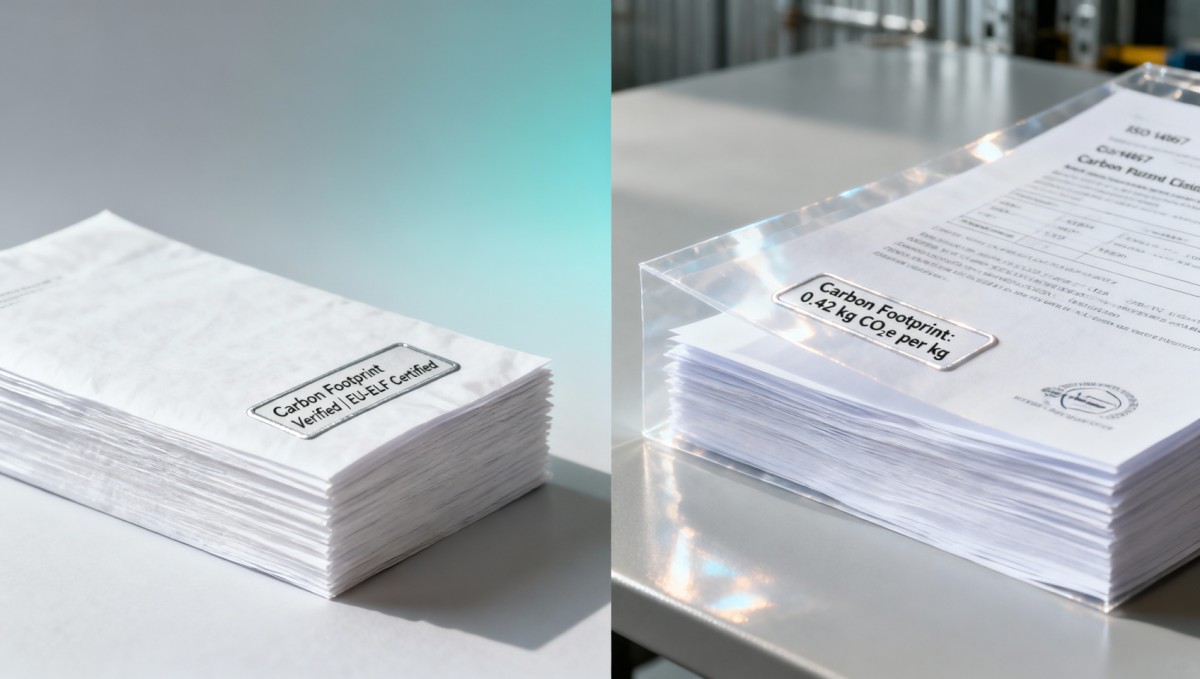
According to an official announcement published on the European Commission’s website on 15 May, the implementing act accompanying the ESPR specifies that, effective 1 June 2026, all packaging paper, specialty paper, and graphic/cultural paper exported to the EU must be accompanied by a verified Carbon Footprint Declaration (CFP). This declaration must be issued by a laboratory or LCA provider recognized under the EU Environmental Labelling Framework (EU-ELF) and included in both B2B technical documentation and export customs declarations. Non-compliant shipments risk rejection at EU borders or delays due to post-arrival verification by accredited third parties. As of publication, only seven Chinese LCA service providers hold provisional EU-ELF recognition.
Industries Affected
Direct Exporters (Trading Companies): These firms act as legal exporters on customs declarations and bear primary compliance responsibility. They must ensure CFPs are validated, correctly formatted, and integrated into export documentation—not merely obtained. Failure may result in cargo detention, rework costs, or contractual penalties with EU buyers.
Raw Material Suppliers (e.g., pulp mills, recycled fiber aggregators): While not directly labeled, their upstream emissions data (e.g., energy mix, transport distances, chemical inputs) constitute >60% of typical paper CFPs. Lack of auditable, granular process data—especially for recovered fiber sourcing—may prevent downstream LCA providers from completing compliant assessments.
Manufacturers (Paper Mills & Converters): They are responsible for providing accurate production-phase data (e.g., electricity source, steam generation, bleaching method) to LCA providers. Mills using coal-fired boilers or non-certified biomass face significantly higher declared footprints—potentially undermining competitiveness against EU-based producers already operating under stricter energy reporting regimes.
Supply Chain Service Providers (Certification bodies, logistics platforms, customs brokers): Their role shifts from advisory to gatekeeping. Brokers must now verify CFP inclusion prior to filing; certification bodies must expand scope to cover LCA-specific audit competencies; and digital trade platforms may need to integrate CFP metadata fields into e-invoicing and e-CMR workflows.
Key Focus Areas and Recommended Actions
Verify LCA Provider Eligibility Early
Only seven Chinese LCA providers currently hold provisional EU-ELF recognition. Exporters should confirm their chosen provider’s status via the EU’s public ELF register—and assess backup options, as provisional recognition does not guarantee renewal. Engaging unlisted providers risks invalidation of CFPs after 1 June 2026.
Map and Document Process-Level Emission Data Now
CFP calculations require site-specific data—not industry averages—for Scope 1 and 2 emissions, raw material transport, and key chemicals (e.g., chlorine dioxide, sodium hydroxide). Mills should begin internal data collection audits no later than Q3 2024 to avoid bottlenecks during LCA validation cycles.
Align Technical Documentation with EU Requirements
The CFP must appear in B2B technical files—not marketing materials—and follow ISO 14067–compliant formatting. Exporters should review current product datasheets and update templates to include standardized CFP fields (e.g., functional unit, system boundary, verification statement).
Assess Impact on Pricing and Contract Terms
CFP verification adds cost (estimated USD 1,200–3,500 per product line) and lead time (4–10 weeks). Exporters should renegotiate Incoterms where possible (e.g., shifting to FCA instead of EXW) and explicitly allocate CFP-related responsibilities and liabilities in new sales contracts.
Editorial Perspective / Industry Observation
Observably, this regulation is less about carbon accounting per se and more about embedding lifecycle transparency into trade infrastructure. Unlike voluntary schemes (e.g., EPD), the EU’s CFP mandate requires real-time data traceability—not just annual reporting—and links compliance directly to customs clearance. Analysis shows that the tight window between the May 2024 announcement and the June 2026 deadline suggests the EU expects rapid adaptation, particularly from major trading partners like China. From an industry perspective, the bottleneck is unlikely to be technical capability but rather institutional coordination: aligning national LCA standards (e.g., GB/T 24040 series) with EU-ELF criteria, harmonizing energy grid emission factors across provinces, and resolving data-sharing protocols between mills and recyclers.
Conclusion
This requirement marks a structural shift—from end-of-pipe compliance to embedded environmental intelligence in trade documents. It does not signal an imminent export barrier, but rather the normalization of environmental performance as a core trade credential. For Chinese paper enterprises, early engagement with verification pathways and data governance frameworks is not precautionary; it is operational necessity.
Source Attribution
Primary source: European Commission, Implementing Act on Environmental Footprint Declarations for Paper Products, published 15 May 2024 (C/2024/3217); accessible via EU Commission’s Regulatory Pipeline Portal.
Note: Final EU-ELF recognition criteria and the list of accredited Chinese providers remain subject to update; stakeholders should monitor the EU Environmental Labelling Framework portal for official revisions through Q2 2025.