products
‹
›
‹
›
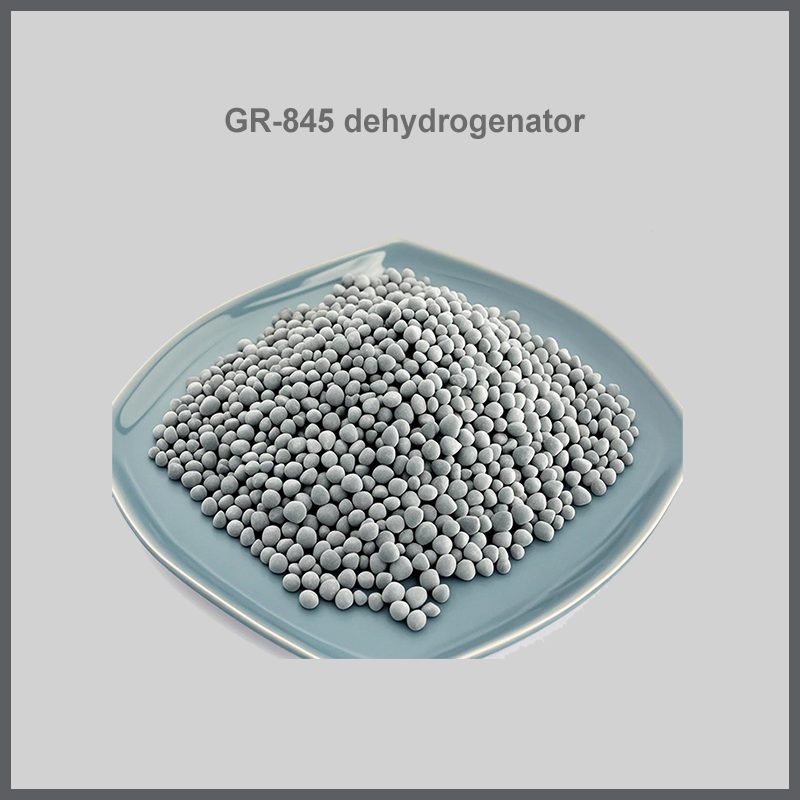
GR-845 dehydrogenator
Beyond the urea industry, this product is widely used in hydrogen-containing gas treatment in a wide range of fields, including petrochemicals, coal chemical industry, metallurgical shielding gases, electronic specialty gases, and scientific research. It combines dehydrogenation and deoxygenation capabilities, and features high activity, high selectivity, strong toxicity resistance, and a long service life.
Product Description
GR-845 dehydrogenation agent is suitable for the removal of trace hydrogen under aerobic conditions, especially for the dehydrogenation of CO2 raw gas in the urea production process to prevent the accumulation of hydrogen in CO2 and explosion.

Working principle
2H2+02→2H2O
Application areas
This product can be used for direct deoxidation of hydrogen-containing gases in petrochemical, coal chemical, metallurgy, electronics, light industry, scientific research, and other new technology fields, or for hydrogenation deoxidation of hydrogen-free gases, or for direct deoxidation of inert gases.
Product Parameters
FAQ
1.Why is it necessary to remove hydrogen from the CO2 raw gas during urea production?
In the urea synthesis process, excessive hydrogen in the CO₂ feed gas can accumulate in the high-pressure system, forming an explosive mixture. The GR-845 can remove hydrogen to a safe level before it enters the synthesis tower, fundamentally eliminating explosion hazards and ensuring production safety.
2.Does GR-845 only work under aerobic conditions?
Yes, its working principle relies on oxygen (O₂) as a reactant for hydrogen, so the raw gas must contain an appropriate amount of oxygen (or artificially added air) to carry out the catalytic oxidative dehydrogenation reaction to produce water.
3.Does this catalyst have other functions besides dehydrogenation?
Yes, GR-845 can also be used for hydrodeoxygenation or inert gas deoxygenation in certain processes, achieving multiple uses with one dose. It is particularly suitable for various gas refining scenarios.
4.What are the advantages of GR-845 compared to traditional methods?
It has the advantages of high and low temperature activity, strong reaction selectivity, a wide operating window, good anti-toxicity, and high mechanical strength. It is particularly good at long-term stable operation under complex working conditions, avoiding frequent catalyst replacement.
5.How is this catalyst typically used? Does it require special activation?
GR-845 is usually provided in an oxidized form. After loading, it generally does not require complex reduction. It can be put into operation at an appropriate temperature by introducing process gas. It is easy to start up and has great operational flexibility. It is suitable for continuous and intermittent conditions.

Request a Quote
Related Recommendations