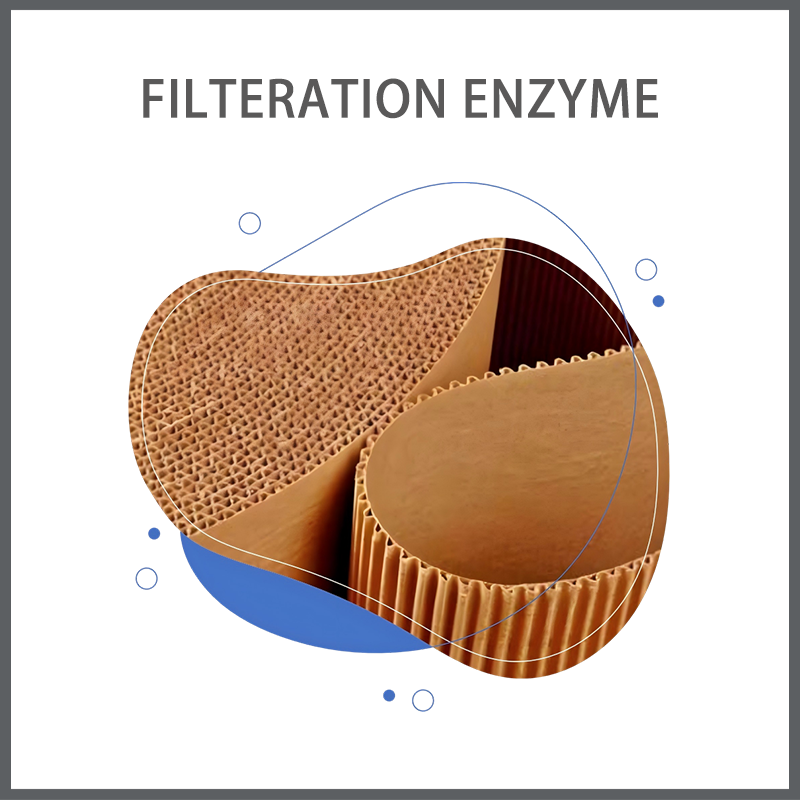
Filteration enzyme

Filtering enzymes specifically refer to enzyme preparations used in the wet end of papermaking to selectively modify fibers, thereby reducing the pulp's water retention value, accelerating the filtration rate, and thus improving paper machine operating efficiency and reducing drying energy consumption. Their main components are screened and optimized cellulases and hemicellulases (especially endonucleases).

Scope of application


Production lines (long-wire paper machines) that have difficulty filtering water from various types of paper, such as linerboard, corrugated paper, whiteboard paper, and cultural paper.


Causes of filtration performance decline


  • Increased fiber reuse frequency

  • Decrease in average fiber length

  • Accumulation of chemicals in white water, leading to increased concentration

  • Accumulation of fine fibers


Features


  • Increased filtration speed

  • Increased machine speed and output

  • Reduced the moisture content of wet paper sheets in the wire section

  • Reduced steam consumption in the drying section

  • Reduced dosage of traditional retention and filtration aids, etc.


Application— TD Paper


Project

before

Difference

Basis weight/m2

120


Head-box consistency/%

1.25

-0.05

Vacuum couch current/A

335

-5

Press vacuum pump current /A

190

-5

Dryness after press/%

42

+3

Speed /m/min

373

+12

Steam consumption /T/T

1.9

-0.05

Cross profile difference /g

3-5


Ring crush Index /N. m /g

8.35

+0.13


Shortened water line, increased machine speed, and improved production output


Application — Laboratory test Data at Asia Pacific Paper


Filteration Time

Filteration Volume

Temperature

Blank

43

800

30

Current Product 100g

37

800

31

GR100g

35.5

800

31

Current Product 200g

36.5

800

31

GR100g

34.5

800

32


The product has passed the pilot production trial.


Request a Quote

Submit

Related Recommendations