products
‹
›
‹
›
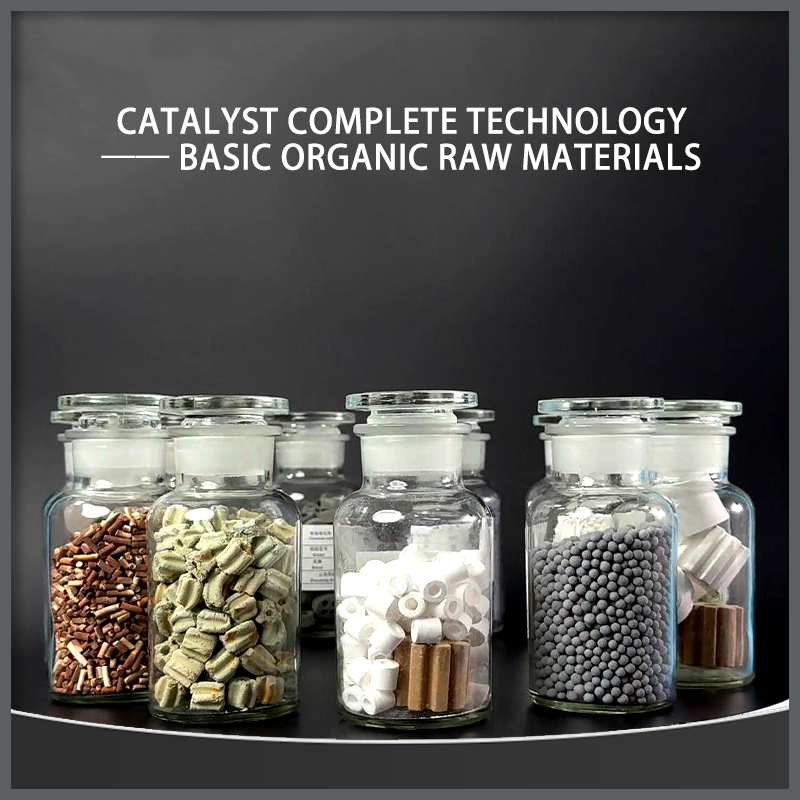
Catalyst complete technology—— Basic organic raw materials
1.S-ANT Acrylonitrile Catalyst Complete Technology
Product Introduction
The primary industrial process for producing acrylonitrile is propylene ammoxidation, in which propylene, ammonia, and air react with a catalyst to form acrylonitrile, acetonitrile, and hydrocyanic acid. This innovative acrylonitrile production technology offers low energy and material consumption. Key technologies include the development of large-scale fluidized bed reactors and quench towers. Advanced processes include refined recovery technology, composite extraction and separation technology, negative-pressure decyanation technology, online blockage-removal technology, improved acrylonitrile refined recovery technology, ammonium sulfate-free technology, and wet oxidation technology.
SANC series acrylonitrile catalyst
The main brands of SANC series acrylonitrile catalysts currently promoted include SANC-08, SANC-11, and SANC-11+. The characteristics of the main products are shown in the table below.

2.Catalysts: S-TDT disproportionation and alkyl transfer complete technology
Product Introduction
S-TDT disproportionation and transalkylation technology is a toluene disproportionation and transalkylation reaction process that uses toluene and C9/C10 aromatics as raw materials to produce benzene and mixed xylenes. The output of mixed xylenes accounts for about 50% of the output of the entire aromatics complex, and it is a key unit of the aromatics complex.
Technical Features
Flexible Operation: By adjusting the toluene/C.A. ratio in the reaction feed, the product mix of xylene and benzene can be adjusted.
High Product Quality: Product benzene purity >99.90%, ethylbenzene/C.A. ratio ≤1%.
Energy Saving and Consumption Reduction: The reaction system and fractionation unit utilize heat-integrated technology, resulting in low energy consumption.
High Reaction Efficiency: Utilizing a large axial-flow fixed-bed reactor and patented gas distributors and collectors, the reaction materials are evenly distributed, effectively improving catalytic reaction performance.
HAT/HLD series catalysts
The main brands of disproportionation and transalkylation catalysts currently promoted are HAT and HLD series, with the following main features: adjustable product structure, reaction raw material toluene/C. A can be adjusted between 10010-0/100, and the product structure of benzene and xylene is adjustable. High space velocity and low hydrogen-to-hydrocarbon ratio: WHSV≤4h, hydrogen-to-hydrocarbon molar ratio>2. High activity and high product yield: total conversion rate ≤48wt%, total selectivity ≤94wt%. High heavy aromatic conversion capacity: C. A conversion rate>60%. High stability: good catalyst stability, single cycle life of more than 5 years.
3.S-STDP Toluene Shape Selective Disproportionation Complete Technology
Product Introduction
The S-STDP toluene shape-selective disproportionation technology uses toluene as a raw material to react and generate benzene and mixed xylenes. The concentration of p-xylene in the mixed xylene product is about 90wt%, which can be separated by shallow cold crystallization to obtain the PX product. When the PX product is obtained by adsorption separation, the unit operating cost of the device can also be greatly reduced.
S-STDP Toluene Shape-Selective Disproportionation Technology
S-STDP toluene shape-selective disproportionation technology uses toluene as a feedstock over a modified molecular sieve catalyst under hydrogenation conditions to produce benzene and mixed xylenes with a high PX concentration. Its technical features include: High activity: Toluene conversion ≤30%, C8 aromatics product selectivity ≥50%; Co-production of premium-quality benzene. Stable operation: The unit operates stably, with an average annual catalyst temperature increase of less than 1°C. High operational flexibility: The unit can operate within a weight space velocity (WHSV) range of 3-4 h'. Excellent shape selectivity: The mixed xylene product contains approximately 90% p-xylene, reducing the load and energy consumption of the subsequent PX separation unit by approximately 30%. The process can be used in conjunction with a primary crystallization separation process for efficient PX production.
SD-series catalysts
The main promoted brands of toluene shape-selective disproportionation catalyst include SD-01 and SD-30. The main technical indicators are as follows: weight space velocity 3-4h, toluene conversion rate ≥33%, benzene product purity ≥99.93%, PX para-selectivity ≥90%, total selectivity ≥95%, B/X molar ratio ≤1.4, first cycle life ≥6 years.
4.Complete technology for toluene-methanol methylation
Product Introduction
S-MTX toluene methanol methylation to xylene technology is a new xylene production technology that combines the coal chemical industry and the petrochemical industry. Methylation technology uses methanol as an alkylating agent to react with toluene to produce xylene. It can achieve the goal of increasing xylene production while keeping the aromatic raw materials basically unchanged, and maximize the utilization of toluene. It is one of the process technologies that effectively adjusts the product structure of benzene and xylene.
S-MTX toluene methylation complete technology
S-MTX toluene methanol methylation technology uses MTX series toluene methylation catalysts and has the following technical features: Simple reaction process: adopts a multi-stage fixed bed reaction process, methanol is fed in stages, and the methyl utilization rate is improved while effectively controlling the bed temperature rise.
Catalyst is regenerable: MTX series catalysts have good hydrothermal stability and can be regenerated repeatedly. Excellent xylene quality: The ethylbenzene content in the reaction product CA is low, and the impurity content in C. An aromatic is low, which can be directly incorporated into the downstream xylene separation unit. Energy saving and environmental protection: reliable reaction heat control scheme, optimized energy-saving heat exchange network, flexible operating mode, and complete environmental protection measures. Large operation flexibility: toluene/benzene can be fed separately or mixed.
MTX Catalyst
Toluene/methanol 2/1~1/1 (mol/mol), weight space velocity ≤5h-1, toluene conversion ≥40%, C8A selectivity ≥80%, EB/C8A ≤0.1%.
5. Combined process of benzene and heavy aromatic alkyl transfer in catalyst
Product Introduction
Benzene and C9 aromatics alkyl transfer catalyst and process technology (BAT) uses benzene and C9 and above aromatics as raw materials to produce toluene and C8 aromatics through alkyl transfer, which is an important means to optimize and adjust the aromatics product structure. In the case of oversupply of benzene products or low market prices, benzene and C9 aromatics alkyl transfer technology is used to convert benzene into high-added xylene and toluene with greater market demand.
BAT Catalyst
The main brand of benzene and C9 aromatics transalkylation catalyst is BAT-100, and its main technical features are as follows:
Wide range of raw material application: raw material benzene/C9+A is 0/100-50/50wt%, and the feed ratio can be adjusted according to product demand.
High activity: under the conditions of WHSV≤4h-1, HHC>2(mol/mol), the total conversion rate per pass is 50wt%.
High selectivity: the total selectivity of toluene and C8 aromatics generated under the raw material composition of benzene/C9+A =50/50(wt) is ≥90wt%.
Low ethylbenzene content: It has excellent dealkylation function, and the EB/CA in the product is <2%, which is suitable for the production of high-quality xylene.
6. Catalyst: Complete set of technologies for the lightening of aromatics
Product Introduction
Heavy aromatics lightning technology uses C9 and higher aromatics as feedstock, producing C8 aromatics through dealkylation and transalkylation reactions. The developed S-HAP heavy aromatics lightening process uses C9+ heavy aromatics as feedstock, producing BTX through lightening reactions and C2-C3 alkanes as by-products. Benzene and toluene can be recovered as needed or recycled to maximize C8 aromatics production. This technology converts the C9+ heavy aromatic components in catalytic reforming oil into mixed xylenes and olefin cracking feedstock, meeting the requirements of oil quality upgrades and product mix adjustments, and helping petrochemical companies achieve integrated oil-to-chemical transformation.
Heavy aromatics lightning catalyst
The catalyst for lightening heavy aromatics is a HAP series catalyst, and the main features of the product are as follows:
High activity: Under the conditions of WHSV≤4h-1, H,/HC>2(mol/mol), the single-pass conversion rate of C9+A is>55wt%.
High selectivity: The lightening products of heavy aromatics are BTX and C2-C3 alkanes. When benzene and toluene are self-circulated, the products are mainly xylene; the raw material composition determines the xylene selectivity, and the xylene selectivity under reforming heavy aromatics raw materials is ≥80wt%.
High stability: The catalyst life is ≥4 years when treating reforming heavy aromatics raw materials, and the reaction performance is stable during operation.
Low hydrogen consumption: Based on reforming heavy aromatics raw materials, the hydrogen consumption is ≤4kg hydrogen/ton feed.
7.Catalytic deolefin technology in aromatic hydrocarbon combined unit
Product Introduction
Paraxylene (PX) is an important basic organic raw material, mainly derived from aromatics complexes using reforming oil as raw material. Trace olefins remaining in reforming oil can seriously affect the subsequent PX production process and product quality. This technology uses a molecular sieve with a specific structure as the catalytically active center under non-hydrogen conditions to convert difficult-to-separate trace olefins into easily separable high-boiling point compounds and then remove them from the C8 aromatics component. The Shanghai Institute has continued to research this technology and has successively developed DOT-100, DOT-200, and DOT-300 catalysts suitable for the reforming unit of the aromatics complex, as well as the IDO-01 catalyst suitable for the isomerization unit. This has solved the environmental problems caused by the large amount of hazardous white clay waste discharged from PX production equipment and promoted the development of green PX production technology.
Catalytic deolefination catalyst
Catalytic deolefination catalysts, the currently main promoted brands include DOT-300 and ID0-01 deolefination catalysts, which have the characteristics of high activity, good stability, long service life, and renewability.
Request a Quote
Related Recommendations