products
‹
›
‹
›
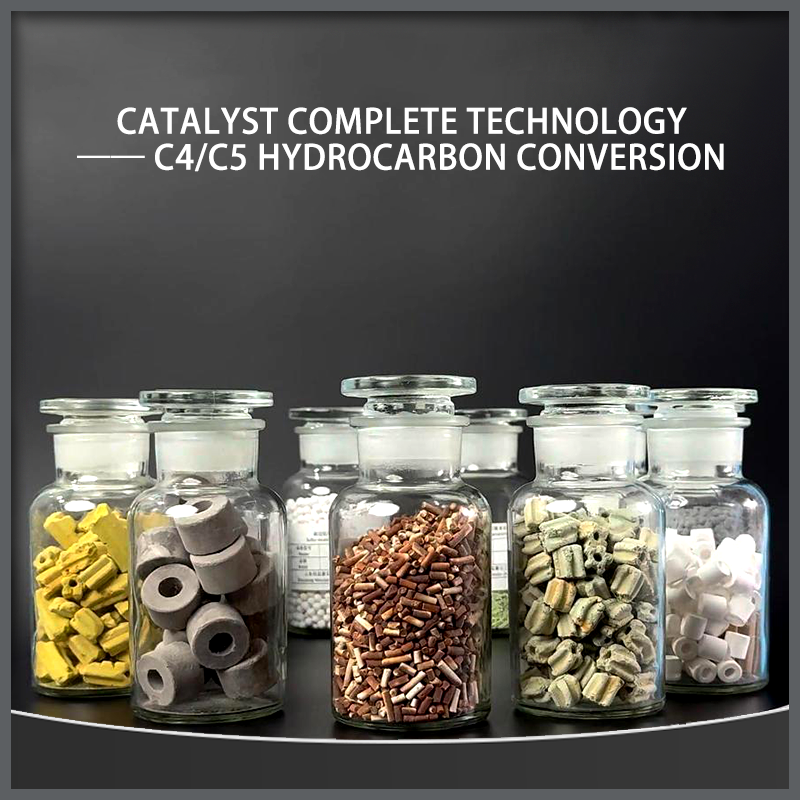
Catalyst complete technology—— C4/C5 hydrocarbon conversion
1.Catalyst: Complete technology for catalytic cracking of olefins (OCC)
Product Introduction
The new generation of OCC complete set technology has a high diene yield, and its material consumption and energy consumption indicators are better than similar foreign technologies. Its technical features are as follows:
High propylene and ethylene yields: The new generation of OCC technology uses a fully crystalline molecular sieve catalyst. Compared with the first generation of technology, the diene yield is greatly improved, and the propylene and ethylene yields are greater than 70% (based on the total amount of raw olefins).
High reaction space velocity: OCC catalyst can be operated under the condition of a weight space velocity of 10-20 h¯', which greatly reduces the volume of the reactor, reduces the investment and operating costs of the device. The new generation of OCC complete set technology has a high diene yield, and its material consumption and energy consumption indicators are better than similar foreign technologies. Its technical features are as follows:
High propylene and ethylene yields: The new generation of OCC technology uses a fully crystalline molecular sieve catalyst. Compared with the first generation of technology, the diene yield is greatly improved, and the propylene and ethylene yields are greater than 70% (based on the total amount of raw olefins).
High reaction space velocity: OCC catalyst can be operated under the condition of a weight space velocity of 10-20 h¯', which greatly reduces the volume of the reactor, reduces the investment and operating costs of the device.
Strong feedstock adaptability: C4/C5 from MTO plants, refineries, and ethylene plants are ideal feedstocks for OCC.
Efficient and low energy consumption: No diluent is required in the reaction feed, reducing energy consumption and the size of the reactor and pipelines. The adiabatic fixed-bed reactor offers a simple structure and low investment. The integrated high-efficiency heat exchanger further reduces energy consumption.
OCC Series Catalysts Product Introduction
The main brands of OCC series catalysts currently promoted include OCC-100A and OCC-200. The characteristics of the main products are shown in the table below.
2.Catalyst: Olefin disproportionation (OMT) technology
Product Introduction
Propylene is one of the important basic organic chemical raw materials, mainly used in the production of polypropylene, isopropylbenzene, acrylonitrile, acrylic acid and many other products. On the other hand, the chemical utilization of C4 resources produced as by-products in large-scale oil refining, ethylene and coal chemical plants is also a focus of the petrochemical industry. OMT technology uses low-yield C4 by-products (mainly butene) as raw materials, reacts them with ethylene, and produces propylene with high selectivity through double bond replacement and recombination.
3.Catalyst: Complete technology for the preparation of 1-butene by double bond isomerization of 2-butene
Product Introduction
1-Butene is a chemically active α-olefin and an important raw material for the production of linear low-density polyethylene, high-density polyethylene, and polybutene. Through research and exploration, we have successfully developed the SIB-I butene dual-isomerization catalyst and isomerization technology package, which converts the economically less valuable 2-butene into high-value 1-butene, increasing 1-butene production and enhancing the comprehensive utilization value of C4 hydrocarbons.

4.Catalyst: Complete technology for butene oxidative dehydrogenation to butadiene
Product Introduction
Butene oxidative dehydrogenation technology produces butadiene through a catalytic oxidative dehydrogenation reaction using butene and air in a steam atmosphere. Butadiene is primarily used in the production of various rubber products, including butadiene rubber (BR) and styrene-butadiene rubber (SBR). Since 2010, research on butene oxidative dehydrogenation to butadiene has led to the development of an iron-based oxidative dehydrogenation catalyst with a composite spinel structure. Based on this catalyst, a corresponding energy-saving butene oxidative dehydrogenation technology package has been developed in collaboration with SEI. The developed ODE-1000TM butene oxidative dehydrogenation catalyst and technology package eliminate the need for steam cracking or catalytic cracking units, providing a dedicated, reliable, and independent source of high-quality butadiene.
Butadiene catalyst
The ODE series of butadiene catalysts is currently the most popular brand. Key product features include:
High activity: The ODE series catalysts operate at low temperatures, have a wide range of space velocities and pressures, and achieve high conversion rates for the raw butene.
High selectivity: The ODE series catalysts significantly reduce the COD content of the deep oxidation product wastewater, significantly reducing material and energy consumption.
High stability: The ODE series catalysts offer a lifespan exceeding 18 months and a single-pass cycle exceeding 6 months, maintaining long-term stable operation and maintaining reaction performance.
Environmentally friendly: The catalysts are free of harmful or corrosive components, are environmentally friendly, and are easy to handle.
5.Catalyst: S-BSI butene skeletal isomerization technology
Product Introduction
SBSI series catalysts use butene as raw material to produce isobutene (normal) through skeletal isomerization. Isobutene is the raw material for producing methyl tert-butyl ether. Methyl tert-butyl ether is mainly used as a clean gasoline additive to increase the octane number of gasoline.
Butene skeletal isomerization catalyst series
The SBSI series catalyst is currently the most popular brand for butene skeletal isomerization catalysts. Its key features are as follows:
High activity: SBSI series catalysts achieve high butene conversion rates and a long unit temperature ramp-up cycle.
High selectivity: SBSI series catalysts produce low levels of heavy oil byproducts, high isobutene selectivity, and high butene utilization, resulting in significant overall plant economic benefits.
High stability: SBSI series catalysts offer a single-pass life of up to three months, stable regeneration performance, and an expected catalyst life of two years. Environmentally friendly: The catalysts are free of toxic, hazardous, and corrosive components, ensuring environmental safety and reusability.
High mechanical strength: The catalysts exhibit high crushing strength, fully meeting industrial application requirements.
6.Catalyst: Complete technology for hydrogenation at both ends of C5 cracking
Product Introduction
The high-temperature cracking process of petroleum hydrocarbons produces a considerable amount of C5 fraction as a by-product. Full hydrogenation of this fraction to produce C5 alkanes as cracking feedstock is an increasingly technically and economically viable option. However, the C5 fraction contains significant amounts of dienes and monoolefins, and its sulfur content is relatively low, placing higher demands on the first-stage catalyst's resistance to polymerization and coking, and the second-stage catalyst's adaptability to low-sulfur conditions. Targeted development efforts have resulted in the development of a C5 first-stage hydrogenation catalyst with high diene hydrogenation selectivity and excellent coking resistance, as well as a C5 second-stage hydrogenation catalyst with high hydrogenation activity and excellent low-sulfur tolerance. Based on these catalysts, a corresponding suite of technologies has been developed.
Cracking C5 hydrogenation catalyst
The catalysts for cracking C5 hydrogenation are SHP-C5-I first-stage hydrogenation catalyst and SHP-C5-1 second-stage hydrogenation catalyst. The main innovations are as follows:
Innovative pore-making technology for alkali metal modification to improve the catalyst's anti-coking performance; innovative preparation of high Ni/Mo ratio impregnation solution and its stabilization technology to improve low sulfur resistance and anti-coking capabilities.
7.Catalyst: SHP-C4 C4 full hydrogenation
Product Introduction
Large quantities of C4 hydrocarbons are produced as by-products during petroleum refining and petrochemical production. Before the 1980s, C4 by-products from catalytic cracking (FCC) in petroleum refining were primarily used to produce alkylate gasoline and composite gasoline, as well as fuel for industrial boilers and civilian applications. The C4 fraction from steam pyrolysis in the petrochemical industry, with the exception of the butadiene fraction, which is used as a raw material for synthetic rubber, is also widely used as industrial and civilian fuel. In recent years, the key process for producing PO has become the oxidation reaction of high-purity isobutane with propylene to synthesize propylene oxide (PO), while also producing tert-butyl alcohol. To obtain high-purity isobutane (≥99.9% wt), the C4 material, after alkane-olefin separation, must be subjected to deep full hydrogenation to ensure that the olefin content in the hydrogenated C4 is below 50 ppm and the sulfur content is below 0.5 ppm.
SHP-C4 C4 full hydrogenation catalyst
The main brand of C4 full hydrogenation catalyst currently promoted is SHP-C4, and the main product features are shown in the table below.
Request a Quote
Related Recommendations