products
‹
›
‹
›
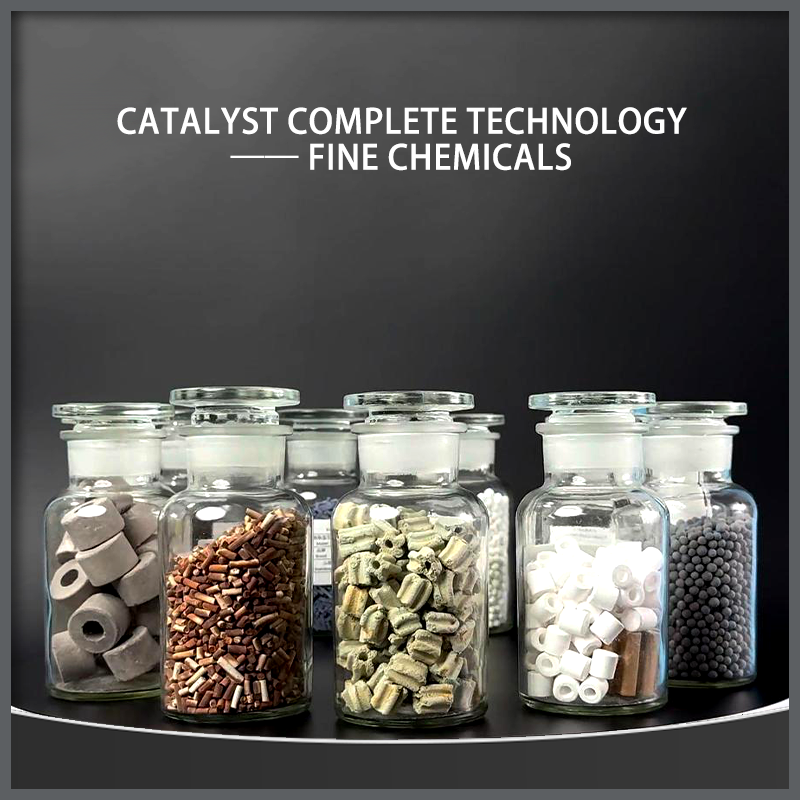
Catalyst complete technology—— Fine Chemicals
1.Complete technology for the ammoxidation of toluene to benzonitrile using catalysts
Product Introduction
The technology of toluene ammoxidation to benzonitrile uses toluene, ammonia and air as raw materials to produce benzonitrile in one step through a gas-phase ammoxidation reaction. Benzonitrile can be used as a solvent to produce nitrile-based rubber, resin polymers and coatings. It is also commonly used to synthesize benzoguanamine, which can be further synthesized into metal coatings, decorative panels, fluorescent pigments, etc.
Catalyst for the ammoxidation of toluene to benzonitrile
The main features of the benzonitrile catalyst are as follows:
Long catalyst life: The catalyst exhibits excellent stability, allowing for a replacement cycle of over five years in industrial applications.
Significantly improved catalyst performance. While maintaining essentially the same toluene conversion rate, the benzonitrile yield increased from 58.5wt% to 92.5wt%, enhancing catalyst selectivity.

2.Catalyst-based complete technology for the ammoxidation of m/p-xylene to m/p-terephthalonitrile
Product Introduction
The m/p-xylene ammoxidation technology to produce m/p-xylene dicarbonitrile (m/p-xylene) is a one-step process using m/p-xylene, ammonia, and air as raw materials. Isophthalonitrile is one of the main raw materials for the broad-spectrum, low-toxic fungicide chlorothalonil and is also used in the production of several fungicides and insecticides. Terephthalonitrile can be used in the production of pyrethroid insecticides. Furthermore, m/p-xylene dicarbonitrile is used in the synthesis of synthetic materials such as nylon barrier resins, isocyanates, and polyimides.
m/p-xylene ammoxidation catalyst
The main features of the m/p-xylene ammoxidation catalyst are as follows:
Long catalyst life: The catalyst exhibits excellent stability, allowing for a replacement cycle of over five years in industrial applications.
The catalyst significantly improves performance. The weight yield of m/p-xylene can reach over 92%.
3.Complete technology for the ammoxidation of halogenated toluene to halogenated benzonitrile
Product Introduction
The technology of preparing halogenated benzonitrile by ammoxidation of halogenated toluene is a reaction technology that uses halogenated toluene, ammonia and air as raw materials to produce halogenated benzonitrile in one step through gas phase ammoxidation reaction. Common halogenated benzonitrile products include o-/p-chlorobenzonitrile, o-/p-bromobenzonitrile, 2,4-dichlorobenzonitrile, 2,6-dichlorobenzonitrile, etc. o-Chlorobenzonitrile can be used to produce azo disperse dyes, and is also one of the raw materials for synthesizing sartan antihypertensive drugs and various anti-inflammatory and bactericidal drugs; p-Chlorobenzonitrile can be used to synthesize widely used pigments and liquid crystal materials; and several other products are used in the synthesis of medicines, pesticides and liquid crystal display materials.
Halogenated toluene ammoxidation catalyst
The main features of the halogenated toluene ammoxidation process are as follows:
Long catalyst life: The catalyst exhibits excellent stability, allowing for a replacement cycle of over four years in industrial applications.
The catalyst performance is significantly improved. The weight yield of halogenated benzonitrile can reach over 87%. This yield is increased by over 20 percentage points compared to the original technology, and the catalyst life is increased by eight times.
4.Complete technology for the production of methylamine by catalytic methanol amination
Product Introduction
Methylamine is an important organic chemical product, widely used in pesticides, pharmaceuticals, solvents, and dyes. The vapor-phase catalytic amination process, using methanol and ammonia as raw materials, is the primary method for producing methylamine both domestically and internationally. Using a silico-alumina solid acid equilibrium catalyst, the reaction produces a mixture of monomethylamine, dimethylamine, and trimethylamine, with a product structure close to thermodynamic equilibrium. Four balanced methylamine catalysts, A-2, A-6, A-6A, and A-16, along with complete process packages, have been successfully developed and commercialized. The A-16 methylamine catalyst demonstrates significant breakthroughs in suppressing side reactions, meeting the needs of green methylamine production.
Methanol amination catalyst for methylamine
The main A-series catalysts currently in use are A-6A and A-16. Their key features are as follows:
High strength, uniform particle size, and low pulverization, which improve airflow distribution and reduce catalyst bed pressure.
High activity, excellent stability, minimal side reactions, and low environmental impact.
Key performance indicators: Methanol conversion ≥99%, DMA selectivity ≥27%, and catalyst life ≥2 years.
5.Catalyst-based heterogeneous process for ethylene carbonate production: complete set of technologies
Product Introduction
Ethylene carbonate is a high-performance solvent, surfactant raw material, and organic synthesis intermediate, and a potential green organic chemical raw material. Currently, electronic-grade ethylene carbonate has become an indispensable solvent for lithium-ion battery electrolytes. Direct catalytic esterification using carbon dioxide and ethylene oxide as raw materials is the primary method for producing ethylene carbonate. Research on heterogeneous catalytic esterification has led to the development of polymer catalysts reinforced with nanomaterials, along with supporting large-scale reactor and refining technologies, resulting in a comprehensive technology package for producing 10,000 tons of green and environmentally friendly ethylene carbonate.
Ethylene carbonate catalyst
The heterogeneous ethylene carbonate catalyst is a spherical particle with the following key features:
High activity: Ethylene oxide is completely converted to ethylene carbonate at high space velocity under low temperature, low pressure, and low activation temperature of 85°C, with material consumption close to theoretical values.
High selectivity: With near-stoichiometric feedstock ratios, ethylene carbonate selectivity exceeds 99%, with minimal side reactions.
High stability: The nano-reinforced material provides excellent swelling resistance and thermal stability, with a service life of over one year. Environmentally friendly: The reaction products contain no environmentally harmful catalyst components, making waste catalyst disposal simple and environmentally friendly.
Request a Quote
Related Recommendations